AI Avatar Generator vs AI Portrait Generator: Which One Should You Use?
TL;DR
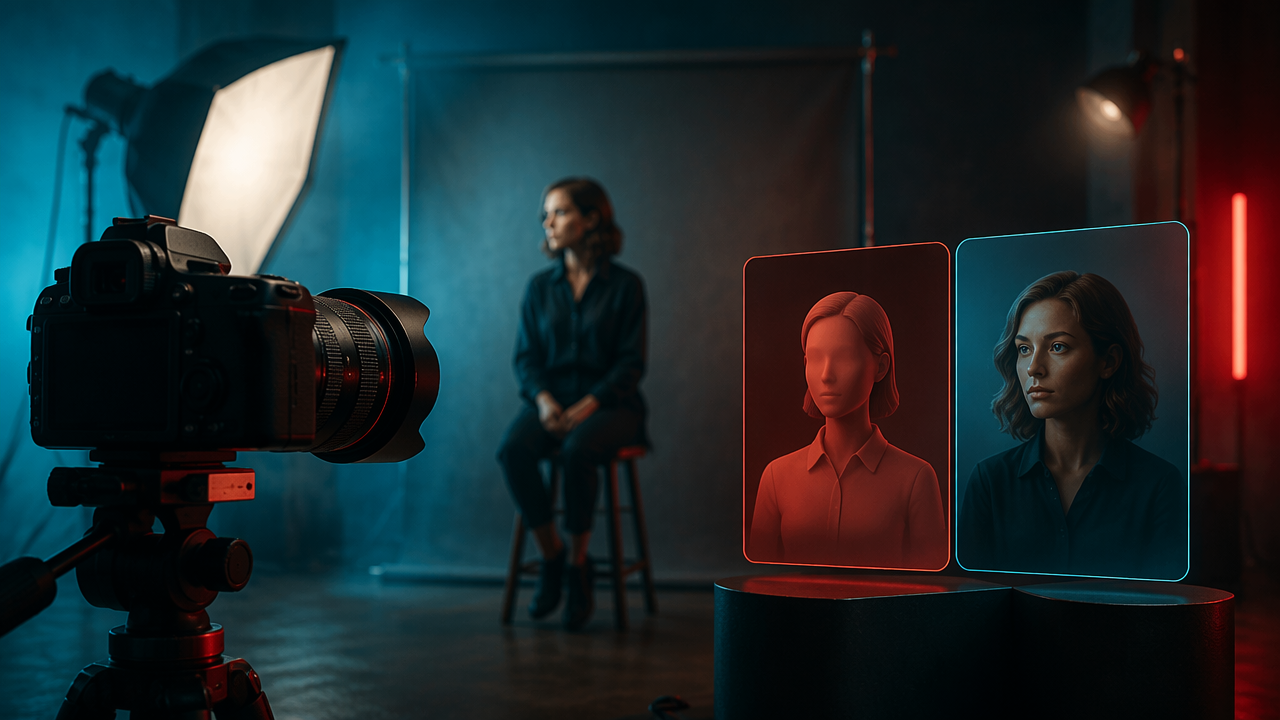
AI avatar generators are best for stylized identity, fantasy looks, gaming, and creator branding. AI portrait generators are better for realistic dating photos, professional profiles, and lifestyle images where you still need to look like you.
A tiny profile image can decide whether someone swipes, clicks, follows, or keeps scrolling, which is why the AI avatar generator vs AI portrait generator question matters more than it sounds. AI avatar generator: a tool that creates a graphical persona, often stylized, symbolic, or character-like. AI portrait generator: a tool that creates a face-forward image meant to resemble a real person, usually with realistic lighting, clothing, and backgrounds. If you want polished personal images without booking a studio, HotphotoAI is built around that practical middle ground: attractive, profile-ready photos that still feel recognizably you.
Table of Contents
What is the difference between an AI avatar generator and an AI portrait generator?
An AI avatar generator creates a digital persona, while an AI portrait generator creates a realistic or artistic image of a person, usually focused on face, likeness, lighting, and presentation. The short version: avatars say "this represents me," while portraits say "this looks like me."
In computing, an avatar is a graphical representation of a user, character, or persona. That can be a cartoon icon, fantasy warrior, anime character, 3D headshot, or branded creator mascot. It does not need to be photorealistic.
A portrait is more grounded in identity and likeness. AI portrait tools often start from uploaded selfies, then generate images with new outfits, scenes, expressions, or lighting. The output can be glamorous, editorial, corporate, cinematic, or soft and natural.
Key insight: avatars are identity symbols; portraits are likeness images. Confusing the two is how people end up with a dragon sorcerer on LinkedIn, which is bold, but perhaps not strategic.
Core terms worth knowing
- Avatar: a visual stand-in for a user, persona, character, or brand identity.
- Portrait: a face-centered image of a person, usually designed to preserve recognizable likeness.
- Stylization: the degree to which an image departs from real-world appearance.
- Photorealism: the degree to which an image looks like a camera photo.
- Identity consistency: how well generated images keep the same facial features across outputs.
AI avatar generator vs AI portrait generator: side-by-side comparison
The fastest way to choose between the two is to compare how much realism, recognizability, and creative freedom you need. Avatars win when the goal is expressive identity; portraits win when trust, attraction, or professional credibility depends on looking real.
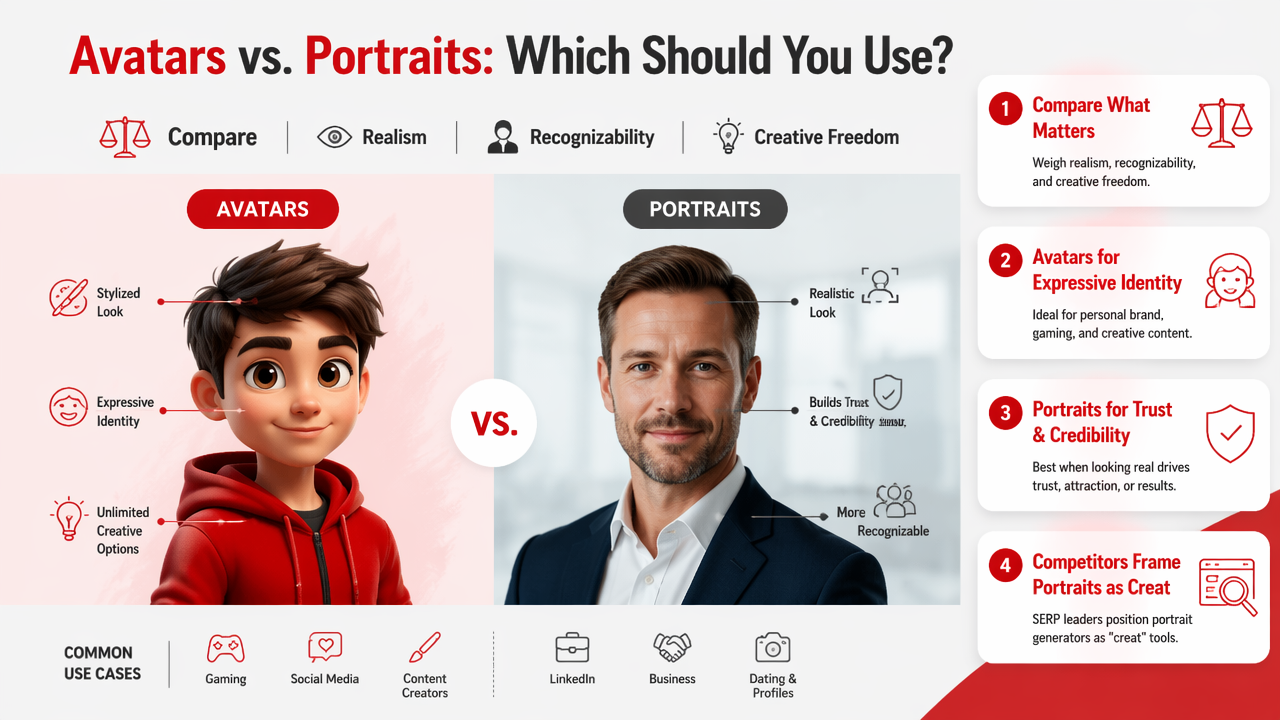
SERP competitors often frame portrait generators as creative tools, but many skip the practical decision points: dating apps, creator branding, work profiles, and recognizable likeness. That is where the distinction becomes useful.
Comparison table by real-world use
| Category | AI avatar generator | AI portrait generator |
|---|---|---|
| Main purpose | Creates a stylized persona or character | Creates a realistic or polished image of a person |
| Realism | Optional, often cartoon, anime, 3D, fantasy, or mascot-like | Usually medium to high realism, with face and lighting as the focus |
| Dating profile use | Fun for secondary images, not ideal as a main photo | Strong fit for main and supporting photos if likeness stays accurate |
| Social media use | Great for creator branding, fandom, gaming, and playful identity | Great for Instagram, X, LinkedIn, thumbnails, and personal branding |
| Professional use | Useful for anonymous or brand-led presence | Better for resumes, LinkedIn, portfolios, speaker bios, and founder pages |
| Creative range | Very wide, including fantasy, sci-fi, anime, 3D, stickers, and icons | Wide, but usually tied to realistic outfits, poses, lighting, and backgrounds |
| Trust factor | Lower when viewers expect a real person | Higher when the image looks natural and consistent |
| Best output | Memorable character identity | Attractive, believable personal image |
A good rule: use an avatar when you want interpretation; use a portrait when you want recognition. If your audience needs to know who they are meeting, hiring, dating, or following, realism matters more than novelty.
Which one should you choose for dating, social media, and work?
Choose an AI portrait generator for dating apps, professional profiles, and realistic lifestyle photos; choose an avatar generator for gaming, fandom, anonymous accounts, creator mascots, and playful visual identity. The right tool depends less on the technology and more on the social promise your image makes.
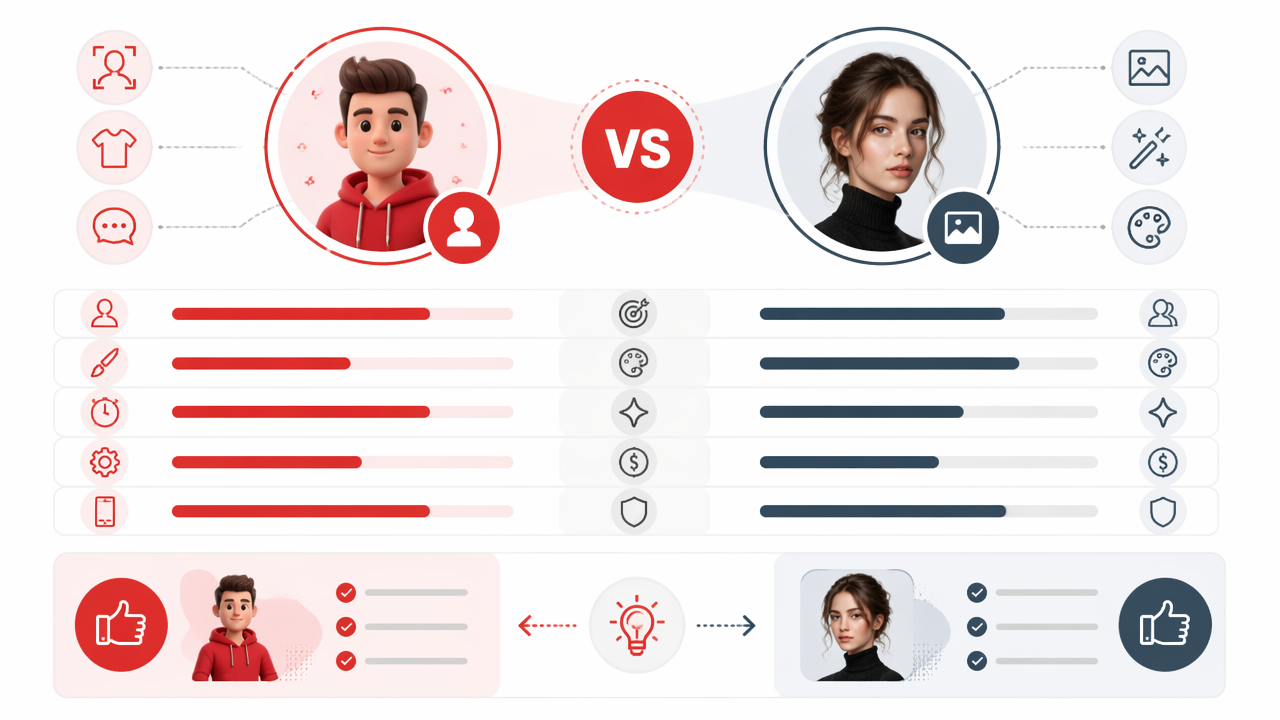
For dating, your main image should reduce uncertainty. A realistic AI portrait can improve lighting, outfit, background, and framing, but it should not turn you into a suspiciously symmetrical yacht owner unless you are, in fact, a suspiciously symmetrical yacht owner.
For social media, the decision is more flexible. A creator might use a stylized avatar as a profile icon and realistic portraits for posts, thumbnails, media kits, or collaborations. The mix can work well when each image has a job.
Decision guide by goal
- Pick an AI portrait generator for Tinder, Hinge, Bumble, or LinkedIn. People expect a real face, not a symbolic version of you.
- Pick an avatar generator for Discord, Twitch, gaming, newsletters, or anonymous accounts. Style and memorability matter more than literal likeness.
- Use both for creator branding. Keep a realistic portrait for trust and an avatar for recognition.
- Prioritize portraits for professional credibility. Recruiters, clients, and collaborators usually need to see a believable person.
- Prioritize avatars for fantasy, roleplay, and worldbuilding. The less reality matters, the more fun avatars become.
- Best for attraction: AI portrait generator
- Best for privacy: AI avatar generator
- Best for personal brand trust: AI portrait generator
- Best for playful identity: AI avatar generator
- Best for character creation: AI avatar generator
If the image has to pass as a plausible photo from your life, choose a portrait. If it has to feel like your alter ego has a costume budget, choose an avatar.
How HotphotoAI handles realistic and stylized personal images
HotphotoAI is best understood as a personal image generator for people who want attractive, profile-ready portraits with room for style. Rather than treating AI images as random art prompts, the HotphotoAI platform focuses on the use cases people actually care about: dating photos, lifestyle shots, polished profile images, and glamour-style portraits.
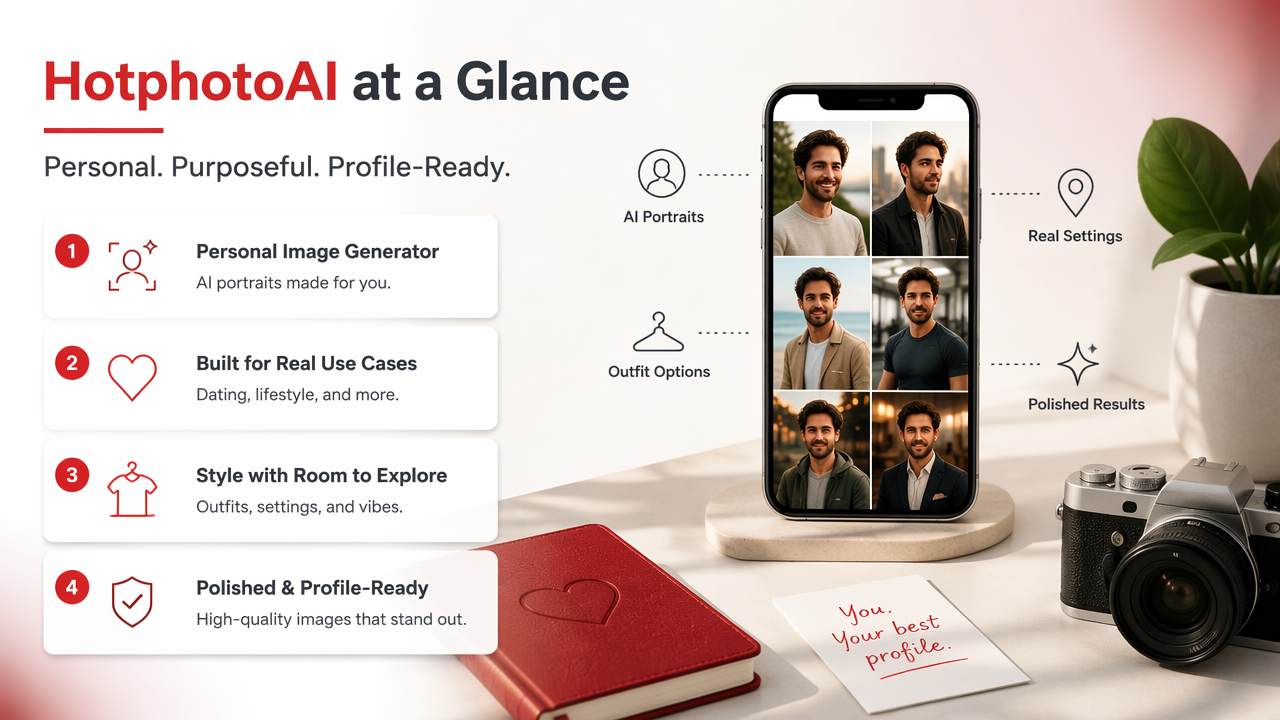
That matters because the most useful AI personal images are not always the wildest ones. They are the ones that make you look confident, current, and believable in a setting that fits your goal. A beach photo, studio portrait, night-out image, or clean professional headshot each sends a different signal.
If you are comparing tools, start with the outcome instead of the label. For dating profiles, I would test realistic lifestyle portraits first, then add one stylized image only if it matches your personality. For creator accounts, I would build a small set: one clean face image, one bolder editorial image, and one avatar-style visual for branding.
You can visit hotphotoai.com when you want the portrait side of the equation to do more of the heavy lifting: better lighting, better scenes, sharper style choices, and images made for online attention rather than a folder named "misc selfies."
Practical image set for most users
- Dating set: 1 clear headshot, 1 lifestyle photo, 1 social-looking scene, 1 polished full-body style image.
- Professional set: 1 clean headshot, 1 relaxed work image, 1 speaker-style portrait, 1 neutral background image.
- Creator set: 1 realistic profile portrait, 1 editorial portrait, 1 stylized avatar, 1 banner-friendly image.
Research on human-centered AI design, such as the 2021 Applied Sciences paper on accessible cultural heritage and AI, supports a simple principle: AI tools work best when designed around human needs, not just technical novelty. Profile photos are a very human need. Vanity is involved, sure, but so are trust, identity, and first impressions.
FAQ about avatars, portraits, and profile use
The most common questions come down to realism, honesty, and platform fit. A strong AI image should match the expectations of the place where it appears, because a LinkedIn headshot and a fantasy Discord avatar are playing two very different social sports.
Is an AI avatar the same as an AI portrait?
No. An AI avatar represents a user, character, or persona, and it can be cartoonish, symbolic, or fictional. An AI portrait usually aims to show a recognizable person, even when the style is glamorous or artistic. The more the image depends on real facial likeness, the closer it is to a portrait.
Are AI portraits good for dating apps?
AI portraits can work well for dating apps when they look natural, current, and close to how you actually appear. Use them to improve lighting, outfits, backgrounds, and confidence, not to invent a different person. The best dating photo still feels like someone could meet you for coffee and recognize you.
Are AI avatars better for privacy?
Yes, avatars are usually better for privacy because they can represent you without showing your exact face. They are useful for gaming, forums, creator identities, and communities where personal anonymity matters. The tradeoff is trust: people may feel less personal connection when they cannot see a real face.
What should change in AI profile images by 2027?
By 2027, expect stronger likeness control, clearer disclosure norms, and more safety checks around synthetic faces. Deepfake research has already focused on both creation and detection, including 2022 surveys in Computer Vision and Image Understanding and the International Journal of Computer Vision. Better tools will likely compete on realism and responsible use together.
Conclusion
The AI avatar generator vs AI portrait generator choice is simple once you name the job. Pick an avatar when you want a memorable persona, privacy, fantasy, or creator branding. Pick a portrait when you need attraction, trust, recognizability, or professional polish.
My practical recommendation: build a small image kit, not one magic picture. Use realistic portraits for dating, work, and public credibility; add one stylized avatar where personality or branding matters. Then test the images where they will actually live, because your audience gets the final vote.