AI-Generated Dating Photos Etiquette: Look Better Without Catfishing
TL;DR
Use AI dating photos to improve lighting, styling, outfits, and settings, but keep your face, body, age, and lifestyle truthful. Disclose heavy edits, skip fake hobbies or fantasy lifestyles, and choose images that a date would recognize within five seconds.
A great dating photo should make someone curious, not make them bring a witness to the first date. AI-generated dating photos etiquette is now a real concern because image tools can fix bad lighting, create polished portraits, and accidentally wander into catfish territory. Used well, HotphotoAI can help you create confident, profile-ready images that still look like you, which is the whole point unless your dating strategy involves being recognized only by your dentist.
Table of Contents
What is AI-generated dating photos etiquette?
AI-generated dating photos etiquette means using artificial intelligence to improve dating profile images while preserving your real likeness, current appearance, and honest social context. The ethical line is simple: improve presentation, not identity. Good edits help people see you clearly; bad edits sell a version of you that your date cannot meet.
Generative AI: a subfield of artificial intelligence that uses generative models to create images, text, audio, video, code, or other data.
Dating: spending time with someone, often through planned social encounters, to get to know them romantically or intimately.
Responsible enhancement: editing lighting, clothing, backgrounds, or style while keeping your face, body, age, and life context recognizable.
Key insight: AI dating photos are not automatically dishonest. They become dishonest when they change the facts someone uses to decide whether to meet you.
Why the etiquette question matters in 2026
Dating apps run on fast visual judgment, so photos carry more weight than most bios, even the ones bravely mentioning sourdough. The rise of AI portraits means users now need a shared norm for what counts as flattering versus misleading.
Research on AR face filters by Ana Javornik, Ben Marder, and Jennifer Brannon Barhorst in Computers in Human Behavior examined why people use augmented face filters and how these tools connect to well-being on social media (2021 paper). That work is not about dating apps specifically, but it gives useful context: appearance technology affects self-presentation, confidence, and how others interpret authenticity.
What should you disclose before a match?
You should disclose AI use when an image changes material facts about your appearance, lifestyle, setting, or activity. Minor polish does not need a courtroom affidavit. Major changes, such as a different body type, luxury travel scene, fake hobby, or younger-looking face, should be labeled or left out.
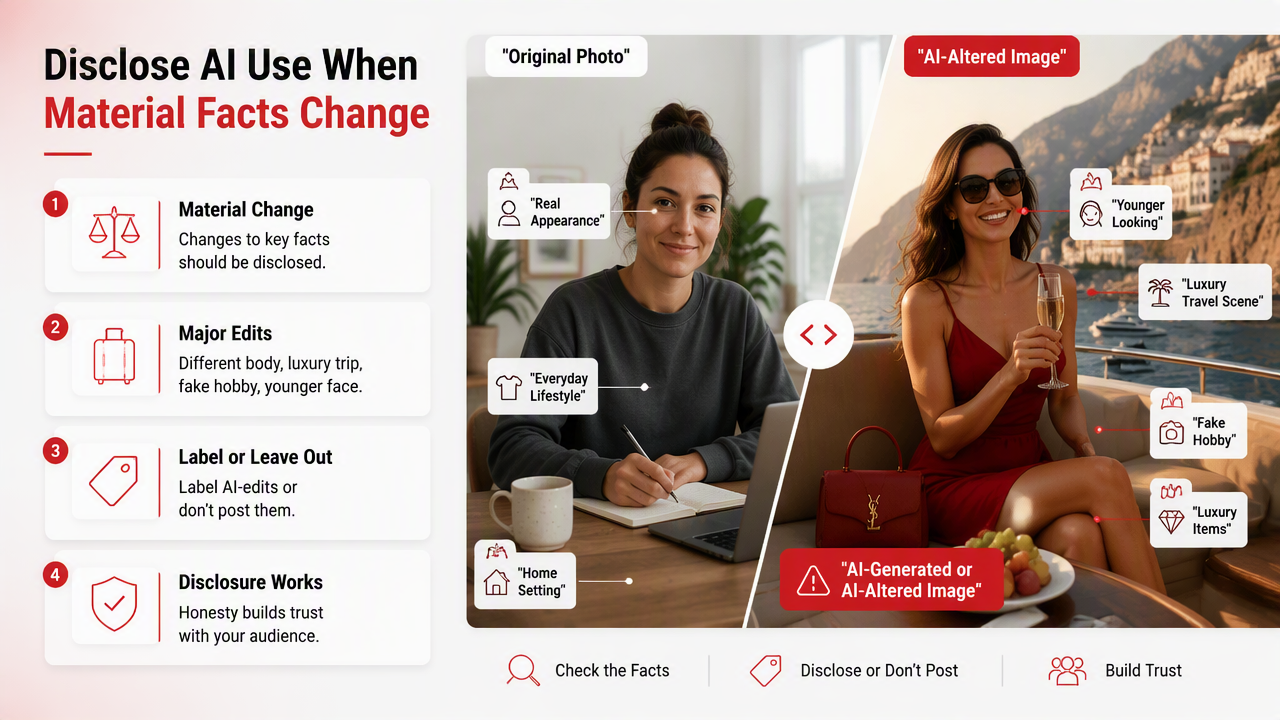
Disclosure works best when it is casual and specific. A simple bio note like, "One portrait is AI-styled, the rest are regular photos," is clearer than a vague "creative photos." Nobody wants to solve a forensic puzzle before coffee.
Do, disclose, and avoid rules
| Photo choice | Etiquette call | Why it matters |
|---|---|---|
| Better lighting on your real face | Do | It improves clarity without changing identity |
| Outfit or background styling | Usually okay | It shows taste, as long as the setting is plausible |
| AI glamour portrait beside real photos | Disclose | It helps matches calibrate expectations |
| Fake travel, fake sports, fake pets | Avoid | It invents lifestyle signals people may match on |
| Smaller waist, altered height, younger skin | Avoid | It changes attraction-relevant facts |
| One stylized fantasy image clearly labeled | Disclose | It can show personality without pretending to be evidence |
A useful test is the five-second rule: if your date saw you at the bar, would they know it was you within five seconds? If yes, the edit is probably presentation. If no, you are not optimizing a profile; you are casting a sequel.
Disclosure lines that sound normal
- "First photo is AI-styled for lighting, the others are regular pics."
- "Trying one AI portrait because my selfie skills are a public health concern."
- "AI-assisted headshot, but yes, that is my actual face."
- "Stylized photo for fun, not claiming I own a villa."
Short disclosure protects trust without turning your profile into a software license. I like phrasing that makes the edit clear and human, because defensiveness usually reads worse than the edit itself.
How do you make AI photos that still look like you?
Make AI dating photos look honest by starting with recent source images, keeping facial structure intact, using realistic settings, and mixing AI-assisted shots with ordinary photos. The goal is not perfection. The goal is a cleaner, more confident version of the person who will actually show up.
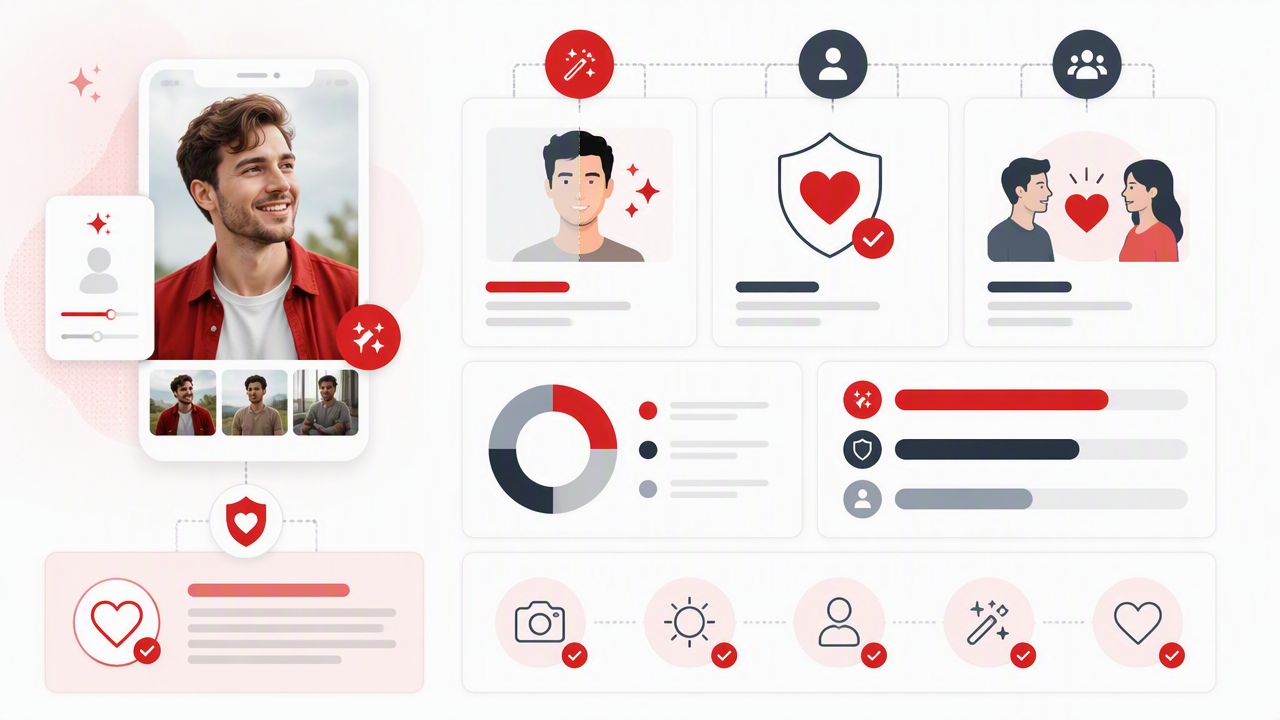
Responsible enhancement works best when the AI image fills a gap: better lighting, a dressier outfit, a warmer background, or a more polished headshot. The HotphotoAI platform is most useful when you treat it like a virtual photoshoot, not a witness relocation program.
A practical creation checklist
- Use recent input photos from the last 6 to 12 months.
- Keep your real hair length, facial hair, glasses, and body shape.
- Choose believable scenes, such as a cafe, city street, studio, gym, or home.
- Match outfits to clothes you would actually wear.
- Include at least two unedited or lightly edited real photos in the profile.
- Ask a friend, "Would you recognize me from this?" before posting.
With HotphotoAI, I would generate a few styles, then reject anything that makes me look like my wealthier cousin from an alternate timeline. The best AI portrait should feel like good lighting found you on a generous day.
Best use cases for responsible enhancement
- Dating profile lead photo: clean face visibility, natural smile, direct eye contact.
- Lifestyle shot: realistic background that supports your personality without faking a hobby.
- Professional crossover photo: polished enough for LinkedIn, warm enough for Hinge.
- Style experiment: outfit, hair, or lighting preview before booking a real shoot.
A 2022 survey on social robots by Hamza Mahdi, Sami Alperen Akgun, and Shahed Saleh reviewed the design and evolution of human-facing artificial agents (ScienceDirect PDF). Dating photos are a different topic, but the broader lesson fits: when technology represents people socially, design choices shape trust.
What are the dating app norms in 2026?
Dating app norms in 2026 generally tolerate AI-assisted photos when they represent the real user, but users increasingly expect honesty about heavy generation. The safer standard is not "Can the app detect it?" but "Would a reasonable match feel misled after meeting me?" That question ages better than any platform loophole.
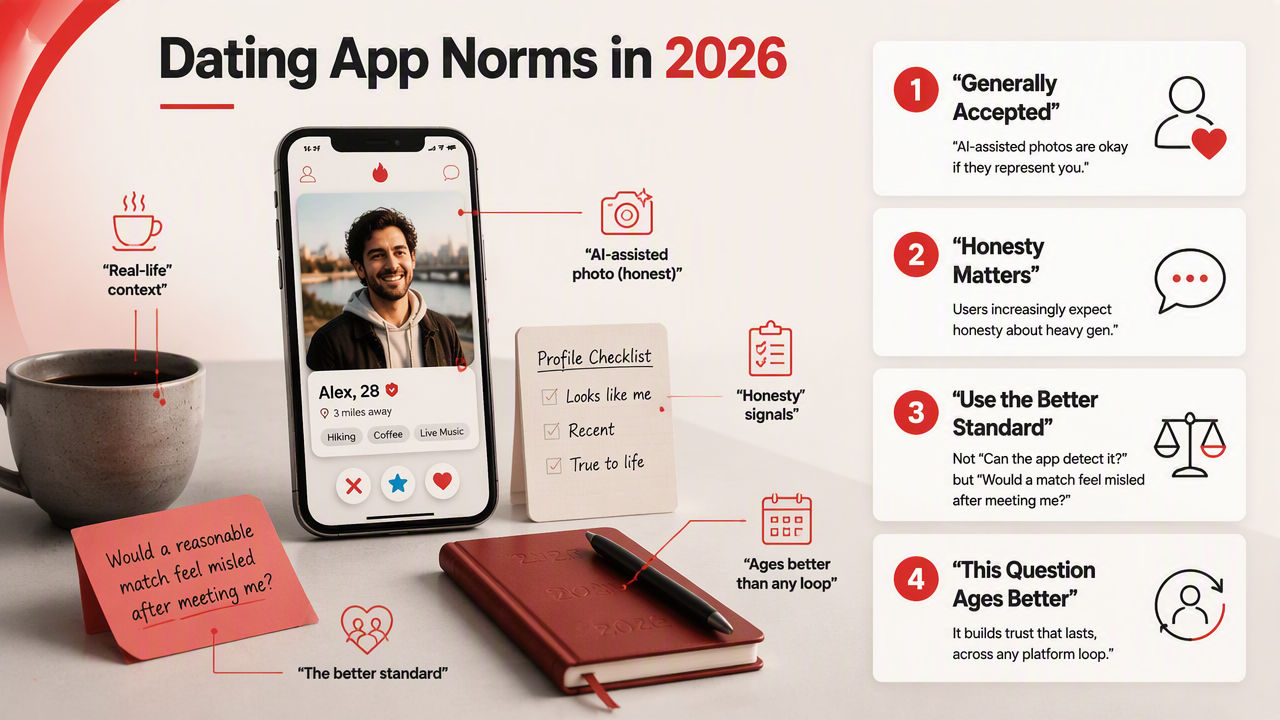
Current search results show strong public interest in whether Tinder, Hinge, and Bumble allow AI-generated dating images. Policy details can change, so check each app's latest rules before uploading. Even when a platform allows AI-assisted images, social trust still decides whether the photo helps or hurts.
Norms that will matter more in 2027
Expect clearer labels, stronger authenticity prompts, and more user reporting around misleading images. Bumble has already been discussed in current competitor coverage for AI photo badging in 2026, which signals where the category may go next.
The smart move is to get ahead of labels by being transparent now. A profile that says "AI-styled portrait plus real photos" feels confident. A profile that hides heavy generation feels like it knows the jury will not be kind.
How to balance attraction and accuracy
Use this hierarchy when choosing photos:
- Recognizable: your real face and current look come first.
- Recent: old photos can mislead even without AI.
- Specific: show taste, activity, or vibe, not a generic model pose.
- Varied: include close-up, full-body, social or lifestyle, and candid-style images.
- Consistent: your photos should look like one person, not a group project.
A polished profile is not the enemy of authenticity. The enemy is surprise, especially the kind that arrives wearing your face but not your truth.
Frequently asked questions
These answers cover the common etiquette questions people ask before adding AI-assisted photos to Tinder, Hinge, Bumble, or social profiles. When in doubt, choose the option that protects recognition, consent, and realistic expectations.
Is it catfishing to use AI dating photos?
AI dating photos are not catfishing if they preserve your real identity and current appearance. They become catfishing when they change your face, age, body, lifestyle, or social proof in ways that would affect someone's choice to match or meet. A flattering portrait is fine; a fictional person is not.
Do I need to label every AI-assisted photo?
You do not need to label tiny improvements like better lighting, cropping, or background cleanup. You should label photos that are fully generated, heavily stylized, or meaningfully different from your everyday look. A short note in your bio is usually enough and feels less awkward than explaining later.
How many AI photos should I use on a dating profile?
Use one or two AI-assisted photos at most, then balance them with regular, recent pictures. A full profile of perfect synthetic images can feel sterile, even if each image is technically attractive. Real photos add texture, trust, and proof that you exist outside a prompt box.
Can AI photos improve matches without being misleading?
Yes, AI photos can help when they fix poor lighting, show better styling, or create a clean headshot from real inputs. The ethical version improves the photo, not the person's facts. If you want to try that approach, head to hotphotoai.com and choose styles you would actually stand behind on a first date.
Conclusion
Good AI-generated dating photos etiquette comes down to one witty but useful rule: do not make your match need a refund from reality. Use AI to show your best lighting, style, and confidence, while keeping your real face, current body, age, and life honest. Start with recent photos, generate a few polished options, label anything heavily stylized, and keep ordinary pictures in the mix. If you want a practical next step, create one realistic lead portrait, one lifestyle image, and one unedited backup, then ask a friend if all three look like the same dateable human.