AI Images Generator for Musician Press Photos: A Practical Guide
TL;DR
Build a three-photo press kit: a hero portrait, recognizable close-up, and lifestyle image. Use a consistent visual brief, check likeness carefully, and verify promotional-use rights before sending files to journalists or promoters.
Your press photo should sell your sound, not introduce your imaginary replacement. An AI images generator for musician press photos can help you explore publicity portraits without arranging a separate shoot for every visual direction. I'd start with a simple brief: recognizable face, coherent styling, and space for editorial layouts. For musicians exploring stylized personal imagery, HotphotoAI offers a relevant starting point for developing that visual direction.
Table of Contents
What makes an AI musician press photo usable?
A usable AI musician press photo preserves your recognizable appearance, communicates your musical identity, and works in real promotional layouts. Treat it as an artist portrait rather than decorative artwork: editors need a clear subject, practical cropping options, and permission to publish the image for its intended purpose.
AI-generated press photo: A publicity portrait created or altered with generative artificial intelligence for an artist's promotional materials.
Text-to-image model: A machine-learning model that produces an image from a natural-language description. Describing a musician isn't the same as preserving a particular musician's identity.
For technical context, Bommasani and colleagues' 2021 foundation-model report examines broad opportunities and risks. Zou and colleagues' 2023 representation-engineering paper studies AI transparency. Neither establishes that a particular portrait generator preserves likeness or grants promotional rights.
Choose portraits by editorial purpose
Each image in your kit should serve a different placement.
| Image | Main job | Useful composition |
|---|---|---|
| Hero portrait | Lead a release announcement or artist page | Medium framing with open background space |
| Close-up | Support interviews and compact profile placements | Clear face that survives a tight crop |
| Lifestyle image | Add context to features and social promotion | Wider scene with a readable subject |
A publicity portrait should make identification easy. Save the mysterious silhouette for the artwork.
How do you create a three-photo press kit?
- Gather recent reference photos showing your current appearance.
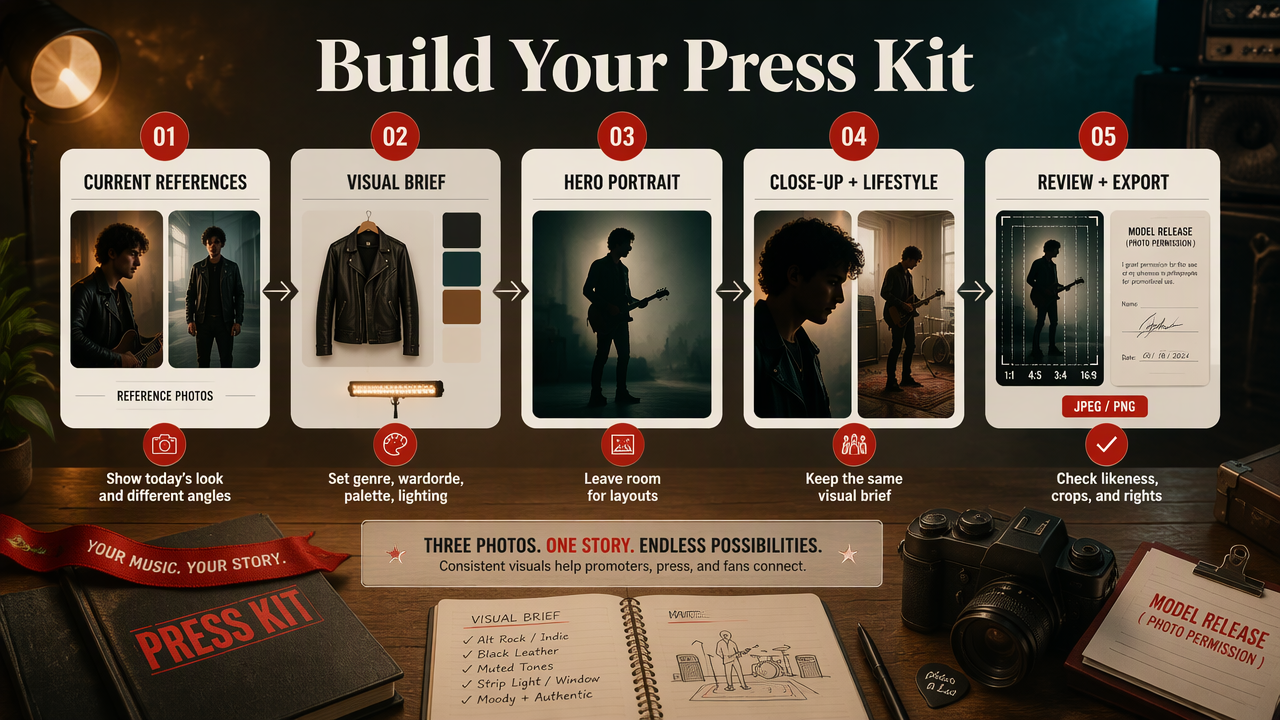
- Define your genre, wardrobe, palette, and lighting.
- Generate a hero portrait with room for layouts.
- Create a close-up using the same visual brief.
- Add a lifestyle scene that fits your identity.
- Review likeness, cropping, and permissions before exporting.
Prepare references that describe the real artist
Choose clear, well-lit photos with different angles and your current hairstyle, facial hair, and distinguishing features. Avoid making every reference a heavily filtered selfie. If a service accepts reference uploads, follow its requirements rather than assuming a particular image count.
For bands, get each member's permission before uploading their likeness. I'd also separate solo-portrait experiments from group-image work: everyone needs an individual likeness review.
Change the scene, not the person
A reusable brief keeps the three images connected. For example, a fictional indie-soul artist could use olive clothing, warm side lighting, and understated interiors throughout.
- Hero: Waist-up portrait against a simple studio background.
- Close-up: Head-and-shoulders framing with the same wardrobe and light.
- Lifestyle: Seated in a quiet rehearsal room, with uncluttered surroundings.
Keep identity details constant while changing composition. I'd leave instruments out unless they add meaning and can be checked carefully. A guitar with architectural ambitions won't help your credibility.
Build a focused visual brief with HotphotoAI
HotphotoAI is a relevant option for exploring stylized personal portraits that support a musician's visual identity. I'd approach the process as art direction: choose one release mood, one wardrobe direction, and a small set of scenes before considering variations.
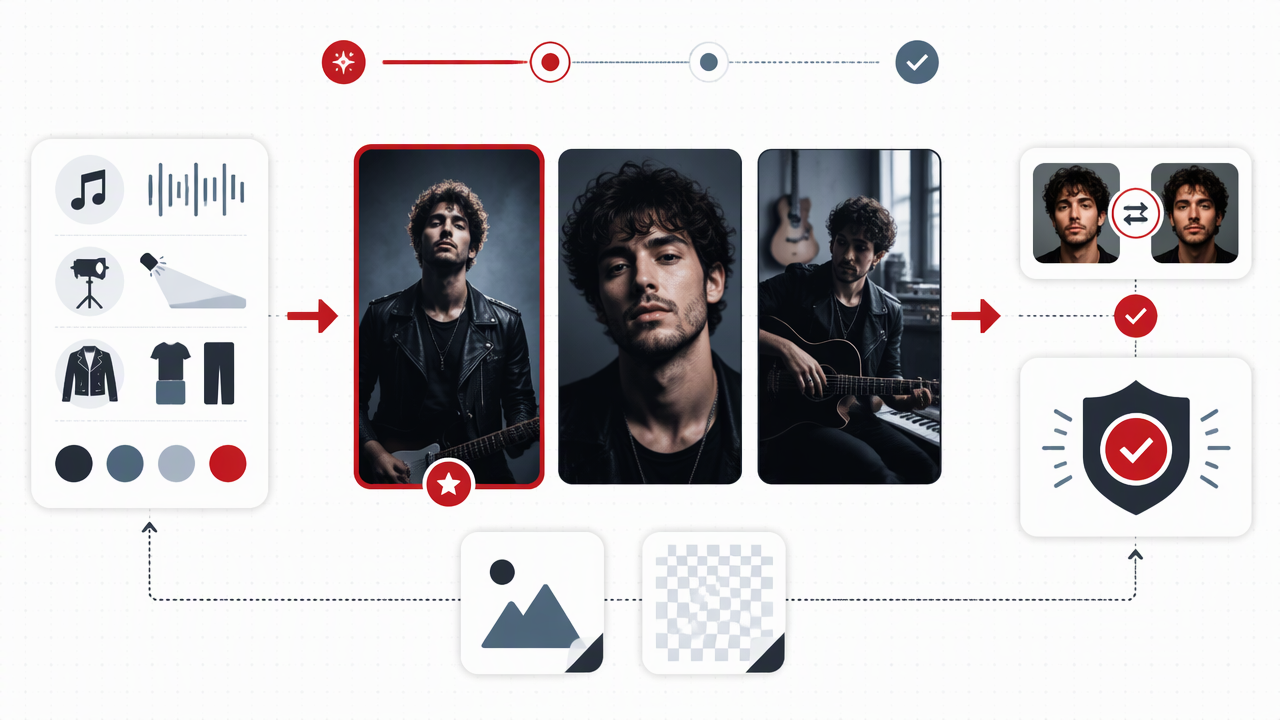
A useful brief might read: Recognizable musician portrait, understated black jacket, soft window light, muted blue background, relaxed expression, waist-up framing, open space on the right. Adapt the wording to the controls available in the service.
Make the release identity easy to repeat
A written brief gives every portrait a shared visual anchor.
- Pick a palette that complements the release artwork.
- Describe clothing you'd plausibly wear onstage or in interviews.
- Choose backgrounds that support your genre without becoming a costume party.
- Keep a record of the brief used for each selected image.
For your next release, visit hotphotoai.com with that brief ready. The aim is a coordinated portrait set you can use across an electronic press kit, artist biography, and social announcement.
What should you verify before publishing?
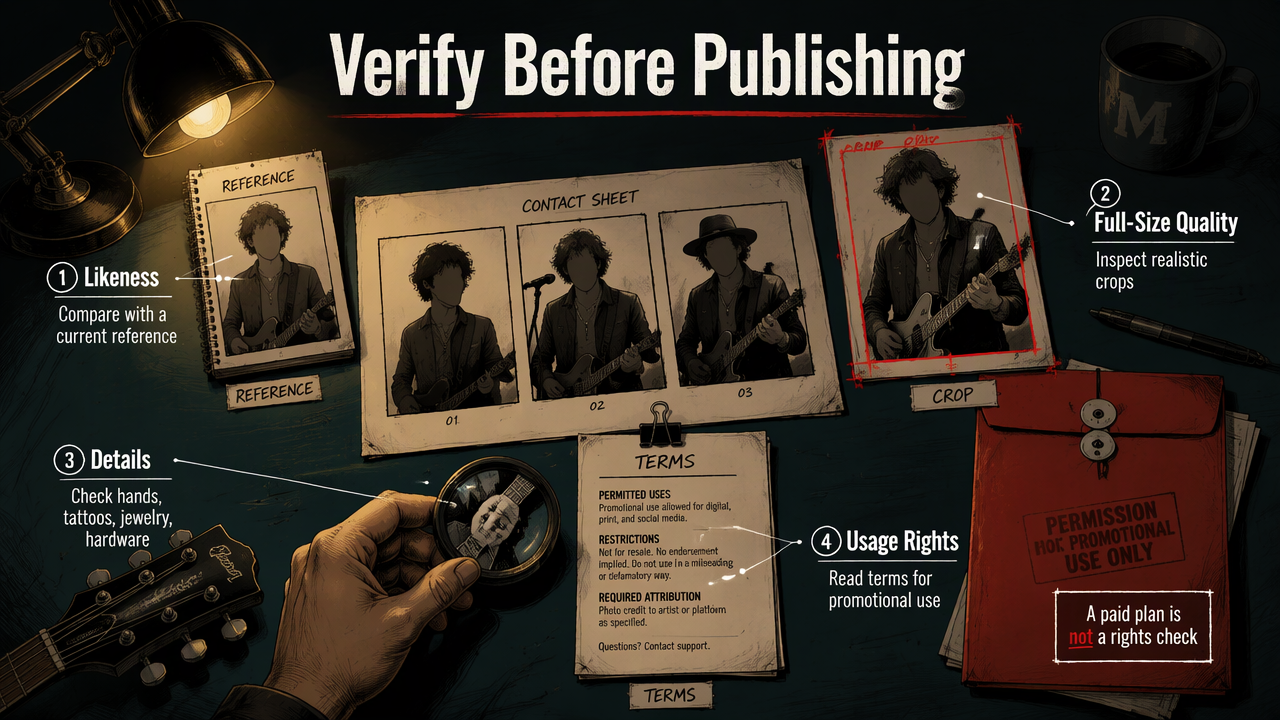
Before publishing AI musician press photos, verify likeness, image quality, source-photo permissions, and the generator's terms for your intended promotional use. Check the actual files at full size and in realistic crops. A convincing thumbnail isn't enough, and a paid subscription alone doesn't explain every usage right.
Check identity and promotional-use permissions
Compare the selected portrait with a current reference. Inspect eyes, teeth, skin details, tattoos, hands, jewelry, and any instrument hardware. Ask someone who knows you to judge recognizability before asking whether the image looks glamorous.
Read the current terms for commercial promotion, paid advertising, attribution, and restrictions. Check upload retention, deletion options, and whether uploaded photos may be used for training. Owning your likeness doesn't automatically mean you own a photographer's source image.
- Keep a dated copy of the applicable terms.
- Record permission for source photos and other people's likenesses.
- Avoid implying a real performance, venue booking, or endorsement that never happened.
Export files editors can actually use
Prepare space and portrait crops from the strongest images, keeping the face away from crop boundaries. Check each recipient's dimensions and file-size requirements rather than guessing a universal standard.
For delivery, JPEG generally suits photographic images and smaller files; PNG is useful when transparency is needed. Retain a high-quality master, avoid repeated recompression, and use clear filenames such as artist-name-hero-press.jpg. Include an accurate credit and identify generated or altered imagery where required.
Musician AI press-photo FAQ
The practical questions concern authenticity, suitability, and file delivery.
Can AI press photos replace a professional photoshoot?
AI press photos can support stylized promotional portraits, but they don't document a real performance or shared moment. I'd use a photographer when the brief depends on live energy, accurate group interaction, or a specific venue. Generated portraits are better suited to controlled visual concepts where recognizability and publication permissions can be checked.
Should musicians disclose that a portrait is AI-generated?
Musicians should follow the receiving publication's rules and avoid presenting a generated scene as documentary evidence. Ask the editor or promoter how they want the image labeled. I'd supply a straightforward production note with the file, especially when the background or setting could suggest an event that never occurred.
Should I send JPEG or PNG press photos?
Send the format requested by the publication or promoter. For ordinary photographic portraits, JPEG is usually a practical delivery choice; PNG makes sense when transparency matters. Keep your original master separately, inspect the exported image, and confirm that compression hasn't softened facial details or introduced visible artifacts around hair.
Conclusion
Start with three clearly defined images, not an endless gallery. Write your brief, prepare current references, and shortlist one portrait for each editorial purpose. Once likeness, permissions, and export requirements are verified, package the files with clear credits and send the kit to your next release's publicist or promoter.