AI Photos for Bumble Profile: How to Look Real, Attractive, and Swipe-Worthy
TL;DR
Use AI photos for a Bumble profile only when they still look like you on a normal Tuesday, not like a fragrance ad with Wi-Fi. Start with clear selfies, create realistic lifestyle variations, keep one verified recent photo, and choose images that signal warmth, confidence, and authenticity fast.
A Bumble photo has about one job: make someone pause long enough to think, "I'd talk to this person." AI photos for Bumble profile use can help when your camera roll is all car selfies, wedding guest crops, and one suspiciously ancient beach photo. Tools like HotphotoAI make it easier to create polished, natural-looking portraits from uploaded selfies, especially when you want better lighting, outfits, and backgrounds without booking a photoshoot.
Table of Contents
What are AI photos for a Bumble profile?
AI photos for a Bumble profile are generated or enhanced profile images created from your real selfies to show you in realistic dating-app contexts. The best versions preserve your face, age, body type, and personal style while improving lighting, composition, outfit variety, and background. The worst versions look like a wax museum got venture funding.
Bumble: Bumble is an American mobile app for online dating and social networking, founded by Whitney Wolfe Herd and launched in December 2014. It is operated by Bumble Inc.
AI dating photo: An AI-assisted portrait used on dating apps to present a realistic, attractive version of a person, usually trained from uploaded selfies or edited from an existing image.
Key insight: Your Bumble photos do not need to look expensive. They need to look recent, clear, approachable, and believable.
Bumble is also moving deeper into AI-aware safety. SERP research shows Bumble Support published 2026 guidance on AI-powered photo feedback, while Bumble also introduced reporting for suspected AI-generated profiles in 2024. That means realism and honesty matter more than ever.
Research on multimodal recognition keeps improving, including a 2024 Nature Communications paper on reconfigurable optoelectronic transistors for multimodal recognition. Dating apps are not the same as lab recognition systems, of course, but the broader direction is clear: platforms are getting better at reading visual signals.
What should Bumble photos communicate in 3 seconds?
Bumble photos should communicate your face, lifestyle, confidence, style, and trustworthiness almost instantly. People are not studying your profile like a tax document. They are scanning for attraction, safety, compatibility, and whether your life looks like something they might want to enter.
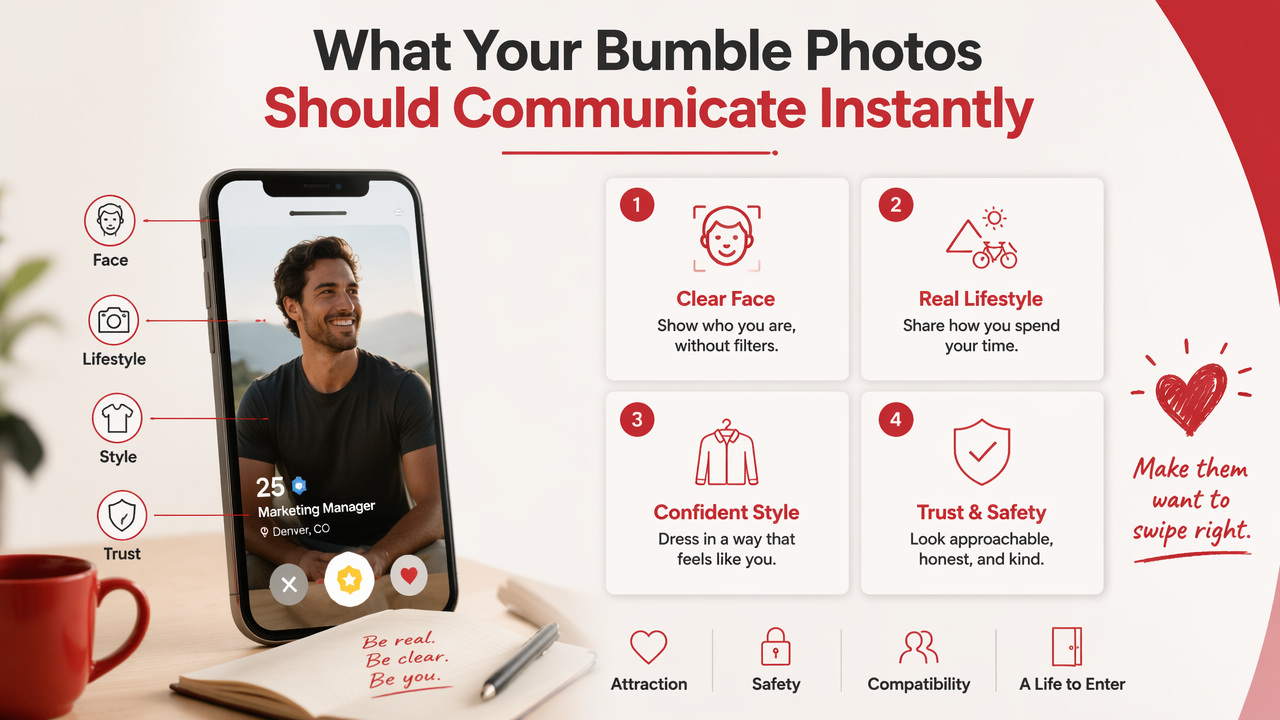
For Bumble, I'd rather see six solid, normal photos than one cinematic masterpiece and five backup goblins. AI can help fill gaps, but the photo set still needs a human rhythm.
Bumble photo signal checklist
| Photo signal | What it tells a match | Best AI-assisted version |
|---|---|---|
| Clear face | "I know what you look like" | Soft daylight headshot, no heavy filters |
| Full or half-body shot | "Your photos are honest" | Casual street, cafe, or travel setting |
| Lifestyle | "You do things besides exist" | Hiking, gallery, coffee, city walk, cooking |
| Style | "You made an effort" | Realistic outfit upgrade, not runway cosplay |
| Warmth | "You seem safe to message" | Natural smile, relaxed posture, eye contact |
| Social proof | "You have a life" | Use a real group photo, not AI-generated friends |
The strongest first photo is usually a clear solo portrait from chest up, with direct eye contact and a real expression. Sunglasses, hats, dark bars, and faraway shots make people work too hard. On dating apps, homework is not sexy.
A good six-photo Bumble mix looks like this:
- Primary portrait: clear face, natural light, genuine smile.
- Style shot: outfit that reflects your taste, not a costume.
- Lifestyle shot: hobby, city, nature, cafe, bookshop, gym, or art space.
- Full-body photo: honest proportions, relaxed pose.
- Conversation starter: pet, cooking, travel, instrument, sport, or creative hobby.
- Real verification-style photo: recent, simple, unmistakably you.
If you use the HotphotoAI platform, start by generating options for the first three slots: portrait, style, and lifestyle. Those are the photos that usually carry the most swipe weight.
How do you generate realistic Bumble photos from selfies?
To generate realistic Bumble photos from selfies, upload varied recent images, choose believable dating-app scenes, keep edits modest, and compare outputs against how you look in real life. The goal is not to create a new identity. The goal is to make your existing identity stop hiding behind bad lighting and laundry-day shirts.
Follow this workflow:
- Upload 10 to 20 clear selfies with different angles, expressions, and lighting.
- Remove confusing inputs like group shots, old photos, heavy filters, sunglasses, or extreme makeup.
- Pick realistic styles such as casual cafe, golden-hour street, smart casual office, weekend outdoors, or dinner date.
- Generate multiple batches instead of trusting the first pretty result.
- Reject face drift where your eyes, jaw, nose, hairline, or age look off.
- Mix AI and real photos so your profile feels current and verifiable.
- Ask one honest friend if the images still look like you.
With HotphotoAI, I'd focus prompts on ordinary charm: "natural daylight portrait," "relaxed smart casual outfit," "city cafe background," or "warm lifestyle dating profile photo." Fancy prompts often produce fancy nonsense. Specific and boring usually wins.
Prompt examples that stay believable
| Goal | Better prompt direction | Avoid |
|---|---|---|
| Approachable first photo | Natural daylight, relaxed smile, simple background | Airbrushed model headshot |
| Confident style | Smart casual jacket, city street, realistic skin texture | Luxury yacht, designer overload |
| Active lifestyle | Weekend hike, soft light, candid posture | Everest cosplay with no oxygen tank |
| Creative vibe | Bookstore, music studio, gallery, coffee shop | Fake awards, fake stage, fake celebrity energy |
Privacy also deserves attention. A 2022 CHI paper on practical experiences accessing personal data under GDPR examined the real-world complexity of personal data access. For dating photos, that means you should read how any service handles uploads, retention, and deletion before sending your face into the machine.
Rule of thumb: If you would feel awkward arriving at a date looking less like your profile than expected, the image is too edited.
What should you avoid with AI Bumble photos?
Avoid AI Bumble photos that change your identity, fake your lifestyle, or make verification harder. Better photos should increase trust, not create a tiny courtroom drama when you meet for coffee.
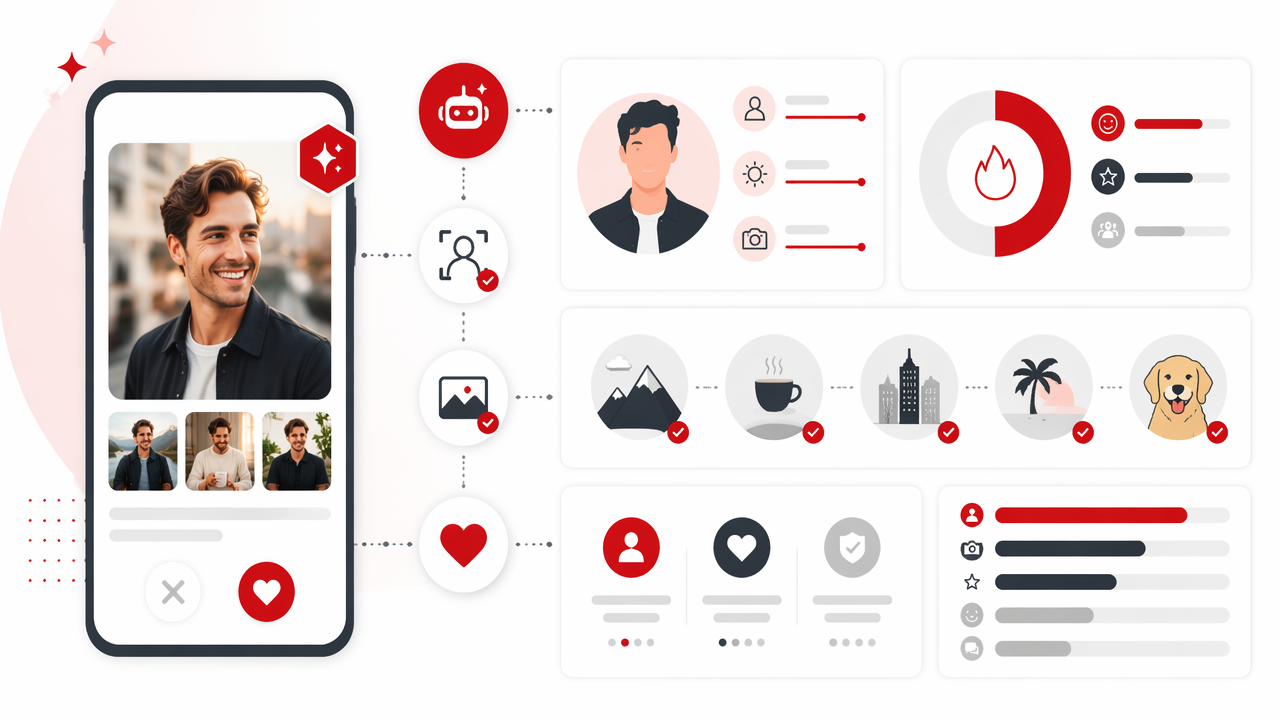
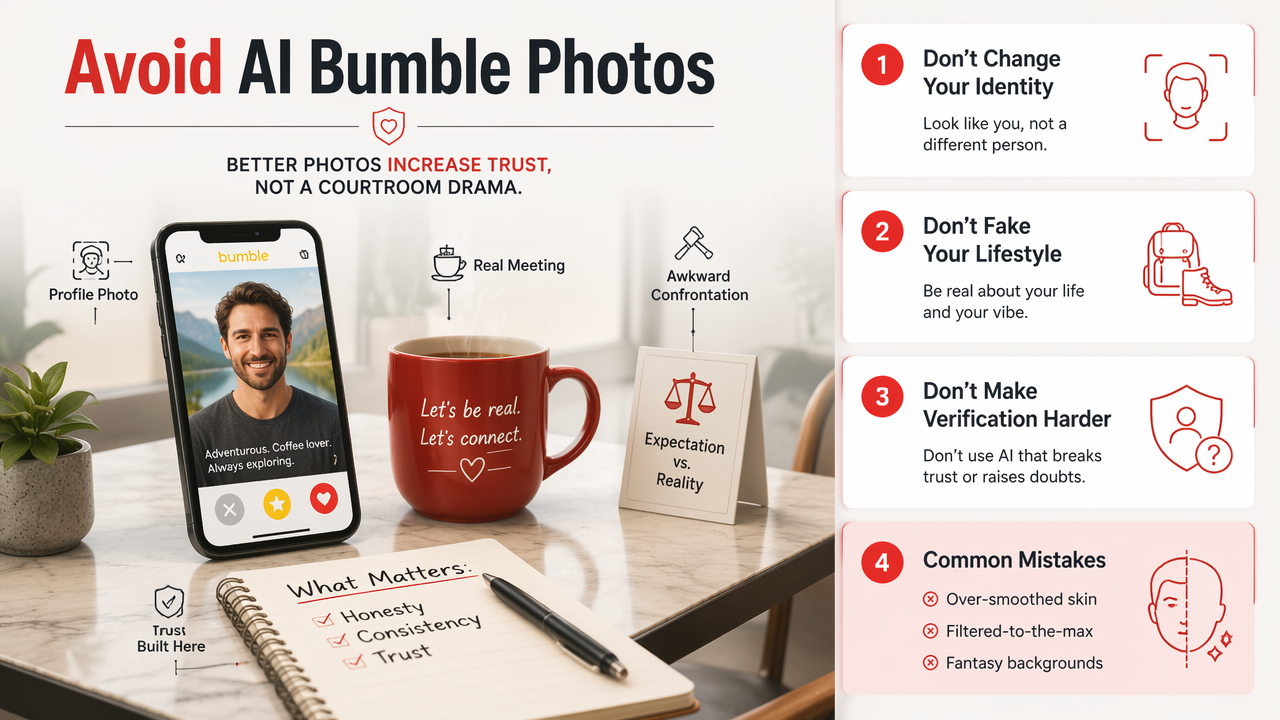
Common mistakes include:
- Over-smoothed skin: real people have pores, texture, and the occasional betrayal from sleep.
- Face drift: the image looks attractive, but not quite like you.
- Fake wealth signals: supercars, penthouses, private jets, or suspiciously empty luxury resorts.
- AI hands and teeth: still the classic crime scene.
- Too many studio-perfect shots: Bumble profiles need variety, not a catalog spread.
- Misleading body edits: they create bad matches and worse first dates.
- All AI, no reality: include at least one recent untouched photo.
Bumble's public direction on verification and reporting shows that platforms want members to trust what they see. SERP research also shows a top-ranking Partnership on AI article focused on how Bumble prevents malicious AI-generated dating profiles. That is a useful reminder: there is a difference between looking polished and pretending to be someone else.
A practical test helps. Put the image beside a current phone selfie. If the AI version looks like your cooler cousin from a perfume campaign, skip it. If it looks like you after good sleep, good light, and better wardrobe planning, it can work.
How will AI dating photos change in 2027?
AI dating photos will likely become more accepted in 2027, but apps will also push harder on disclosure, verification, and authenticity checks. The winning profiles will not be the most synthetic. They will be the clearest, most human, and easiest to trust.
Expect three shifts:
- More in-app AI feedback: Bumble already shows movement here through AI-powered photo feedback noted in 2026 SERP results.
- Stronger authenticity signals: verification prompts, user reports, and visual consistency will matter more.
- Better personal generation tools: users will expect outfit, background, lighting, and style control without losing likeness.
For creators, professionals, and dating app users, this is good news. You will have more ways to test looks before uploading. The smart move is to build a photo set that feels edited by taste, not by panic.
If you want realistic options without planning a full shoot, create a few controlled batches, compare them honestly, and save only the ones that still feel like you. You can visit hotphotoai.com when you are ready to test a cleaner Bumble-ready set.
FAQ about AI photos for Bumble profile
Are AI photos allowed on Bumble?
Bumble's safety direction suggests the issue is not simple AI assistance, but misleading or malicious profile use. Use images that accurately represent your face, age, and lifestyle. Keep at least one recent real photo, complete photo verification when available, and avoid anything that could make another user feel tricked.
How many AI-assisted photos should I use?
Use two or three AI-assisted images in a six-photo set, then balance them with recent real photos. That gives you better lighting and variety without making the profile feel manufactured. I'd use AI for the portrait, outfit, and lifestyle slots, not for fake friends or fake achievements.
Can AI photos improve Bumble matches?
Better photos can improve first impressions, but no reliable source in the provided research gives a universal match-rate statistic. Treat AI photos as presentation help, not a magic match machine. Clear face, warmth, style, and authenticity usually matter more than looking unrealistically perfect.
What is the safest way to start?
Start with recent selfies in normal lighting, generate realistic options, and reject anything that changes your core features. Then show the final set to a friend who has seen you this month, not just during your best era. For a focused test, head to hotphotoai.com and create one natural portrait batch first.
Conclusion
Use AI photos for Bumble profile improvement like a smart stylist, not a witness protection program. Build a set with one clear face photo, one style photo, one lifestyle image, one honest full-body shot, and at least one recent real picture. Then test the set for a week, track match quality, and replace anything that feels too polished to trust. Your best profile should look like you, just better lit and less cursed by the front-facing camera.