AI Photoshoot vs Traditional Photoshoot: Which Is Better in 2026?
TL;DR
AI photoshoots are best when you need many polished portraits quickly, cheaply, and in multiple styles. Traditional photoshoots still win for tactile realism, live direction, events, and high-stakes brand work where every detail must be controlled in camera.
The AI photoshoot vs traditional photoshoot decision is no longer a novelty debate; it's a practical choice about time, money, image control, and how real you need the final portrait to feel. For personal images, dating profiles, creator content, and polished online headshots, HotphotoAI makes the AI side especially direct: upload 15 photos and get hundreds of personalized images in about 10 minutes. A studio shoot, meanwhile, still gives you a living photographer, real lighting, and the useful terror of being told what to do with your hands.
Table of Contents
What is the difference between an AI photoshoot and a traditional photoshoot?
An AI photoshoot creates new portraits from uploaded images, prompts, or model training, while a traditional photoshoot captures a person with a camera, photographer, lighting, wardrobe, and location. The main difference is production method: AI generates variations digitally; traditional photography records a real session.
AI photoshoot: a software-based portrait process that generates styled images of a person using reference photos and machine learning.
Traditional photoshoot: an in-person image capture process involving a camera, photographer, subject, setting, and often hair, makeup, wardrobe, or studio gear.
Key insight: AI is strongest when you need range. Traditional photography is strongest when you need documentary truth.
Research on digital identity helps explain why the distinction matters. A 2025 Journal of Business Research paper on virtual influencer marketing and identity construction examined how audiences make meaning from synthetic personas. For portraits, that means realism is not just pixels; it is whether the image matches how people expect you to look.
How do cost, speed, and creative control compare?
AI photoshoots usually win on speed, volume, and style testing, while traditional photoshoots win on live direction, physical realism, and precise capture. SERP research for this topic found competitors citing traditional production at about $55 to $160+ per image, while AI image costs were described around $2 to $3 per image.
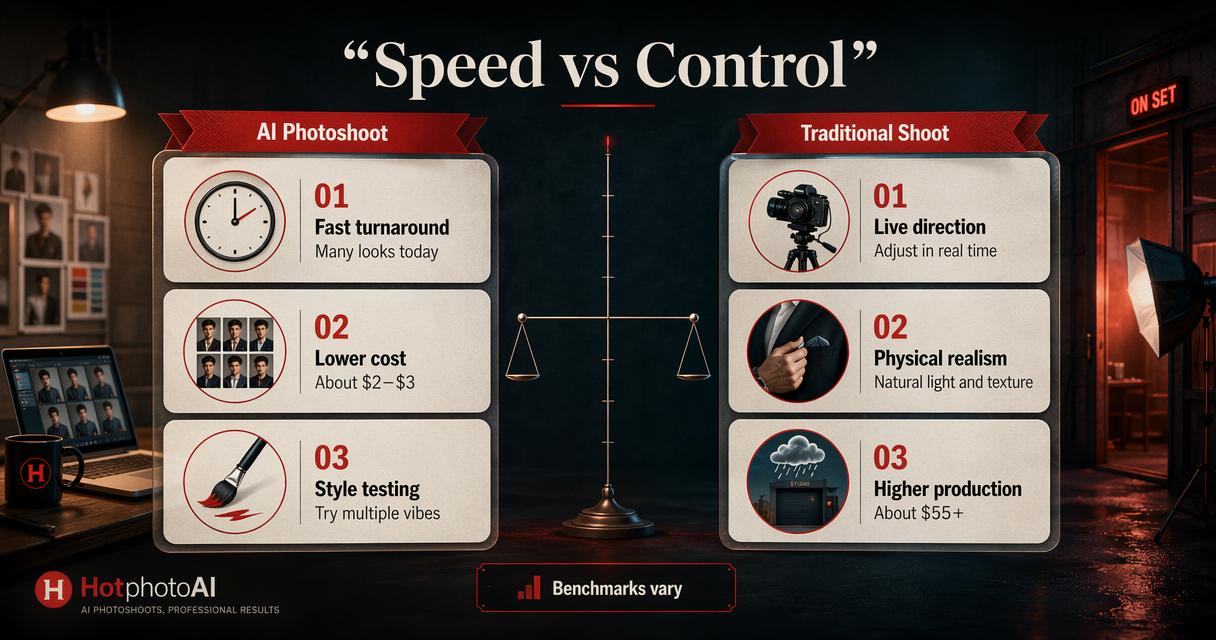
Those figures should be treated as market benchmarks, not universal prices. A luxury portrait photographer, commercial studio, or destination shoot can cost far more. A simple AI package can cost far less than rescheduling a photographer because it rained, your blazer wrinkled, or your dog chose chaos.
Comparison table for real buying decisions
| Factor | AI photoshoot | Traditional photoshoot | Practical winner |
|---|---|---|---|
| Turnaround | Often minutes to hours | Usually days to weeks | AI |
| Cost per usable variation | Low after setup | Higher due to labor and logistics | AI |
| Creative variety | Easy to test outfits, backgrounds, moods | Limited by shoot plan, location, wardrobe | AI |
| Live posing help | Prompt-based, no human coaching | Photographer can direct expression and posture | Traditional |
| Physical accuracy | Can vary by tool and inputs | Captures real face, body, fabric, light | Traditional |
| Reshoots | Fast digital regeneration | Requires another session or edit round | AI |
| Emotional nuance | Can look polished but staged | Better for chemistry, movement, events | Traditional |
For pure efficiency, AI feels almost unfair. For once-in-a-lifetime moments, I would still hire a human with a camera and a backup battery.
Which option is better for dating, social, professional, glamour, and fantasy portraits?
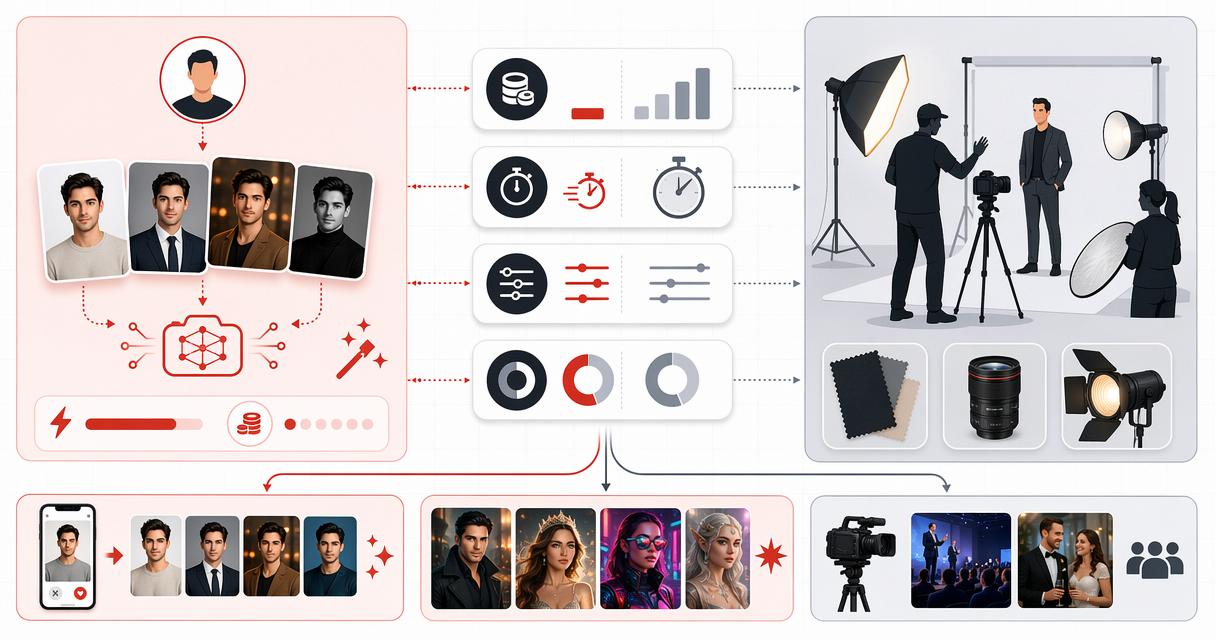
AI is usually better for profile experimentation and stylized personal branding, while traditional photography is better for events, luxury editorials, team shoots, and images that must prove a real moment happened. The best choice depends less on technology and more on where the photo will live.
A dating app portrait has a different job than a corporate headshot. A fantasy portrait can be theatrical; a LinkedIn image should not make you look like you were promoted to space emperor unless that is, somehow, your industry.
Use-case guide by portrait goal
| Use case | Best choice | Why |
|---|---|---|
| Dating profiles | AI first, then optional real shoot | Lets you test styles, outfits, and first-photo energy fast |
| Instagram or creator content | AI for variety, traditional for signature campaigns | AI feeds the content calendar; studios add prestige |
| Professional headshots | Either, depending on strictness | AI works for polished online profiles; traditional suits regulated or executive contexts |
| Glamour portraits | AI for fast style range | Easy to try lighting, fashion, and editorial looks |
| Fantasy or cosplay portraits | AI | Lower cost for impossible sets, costumes, and worlds |
| Weddings, graduations, live events | Traditional | The real moment is the product |
How HotphotoAI handles personal portrait variety
HotphotoAI is built for users who want many personalized images without planning a full shoot. Uploading 15 photos gives the system enough personal reference material to create hundreds of images in about 10 minutes, which is useful for testing dating profile looks, lifestyle portraits, polished headshots, glamour edits, and fantasy styles.
That volume changes the decision. Instead of betting everything on one outfit, one background, and one awkward half-smile, you can compare dozens of looks before choosing what feels most like you.
Where do AI photoshoots still fall short?
AI portraits can miss identity details, create unnatural artifacts, or make a person look slightly too perfect, while traditional photography can be slower, more expensive, and less flexible after the shoot. The smartest choice is not "AI good" or "camera good"; it is matching risk to use case.
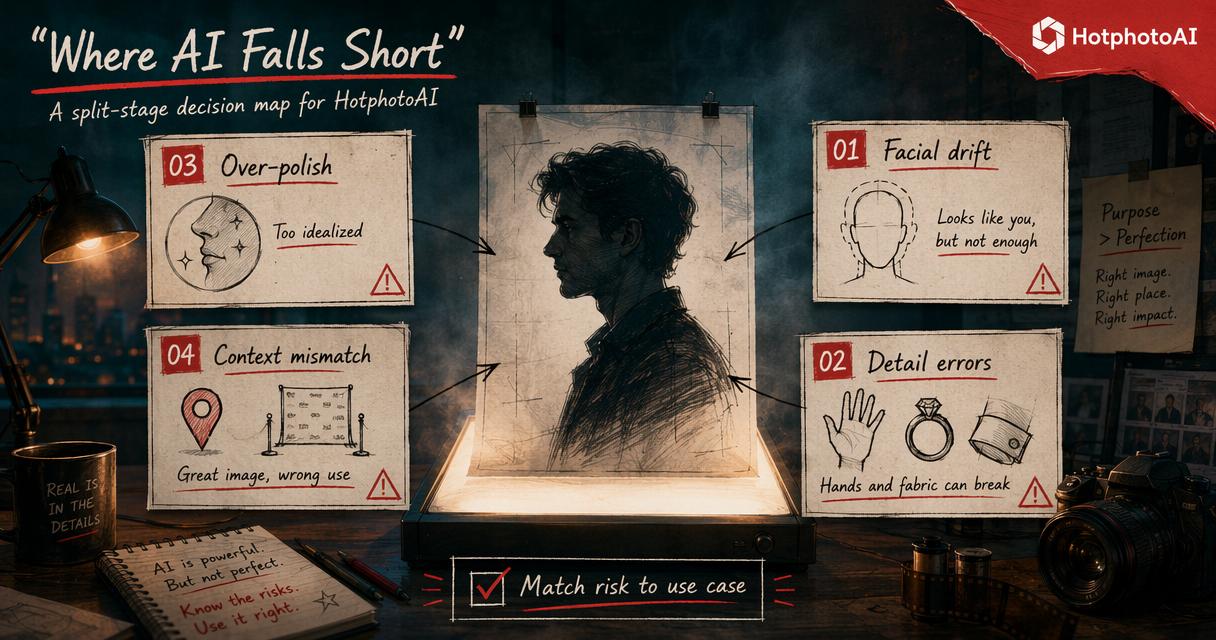
Common AI limitations include:
- Facial drift: the portrait resembles you, but not enough.
- Hand, jewelry, or fabric errors: small details can look odd on close inspection.
- Over-polish: skin, lighting, and proportions may feel too idealized.
- Context mismatch: an image may look great but not fit the platform's norms.
- Disclosure concerns: some audiences care whether an image is generated.
Traditional shoots have their own friction points:
- Scheduling depends on people, place, weather, and availability.
- You may get fewer final images from a full session.
- Wardrobe and location changes take real time.
- Bad posing chemistry can limit results.
- Retouching may add cost and delay.
A 2023 arXiv paper on social reasoning in language models studied how models handle social reasoning tasks. That topic matters here because portrait quality is partly social: a technically clean image can still feel wrong if the expression, setting, or implied status does not match the viewer's expectations.
Rule of thumb: use AI when variation matters most; use traditional photography when proof, presence, and real-world specificity matter most.
How should you choose between AI and a photographer in 2026?
Choose AI when you need fast, affordable, varied portraits for online use; choose a traditional photographer when the shoot itself, the real setting, or human direction is essential. For many people, the best 2026 workflow is hybrid: generate ideas with AI, then book a photographer only for the final high-stakes images.
Decision checklist before you spend money
- Define the platform. Dating, LinkedIn, Instagram, and acting portfolios have different realism standards.
- Set the risk level. If the image must document a real event, hire a photographer.
- Count the variations needed. If you want many outfits or backgrounds, AI saves time.
- Check your source photos. Better input images usually mean better AI output.
- Review details at full size. Look at hands, teeth, glasses, logos, and face shape.
- Ask for outside feedback. Friends spot "almost you" faster than you do.
When a hybrid workflow works best
A hybrid approach starts with AI concepts, then uses traditional photography for final capture. For example, generate 50 possible headshot styles, pick three that suit your face and career, then show those references to a photographer. You save planning time and reduce the chance of paying for a shoot that looks like everyone else's.
The reverse also works. Take one strong real photoshoot, then use AI to explore seasonal backgrounds, alternate outfits, or creator-friendly variations. That is especially useful when you need fresh images but do not need a new camera session every month.
FAQ about AI photoshoots and traditional photoshoots
Are AI photoshoots worth it for dating apps?
Yes, AI photoshoots can be worth it for dating apps if your goal is to test better lighting, outfits, and first-photo options quickly. Keep the images believable, avoid extreme glamour if it does not match your real-life appearance, and choose photos that still look like someone your date could actually meet for coffee.
Can AI replace a professional photographer?
AI can replace some casual portrait sessions, especially for social media, dating, and fast profile updates. It should not replace a professional photographer for weddings, live events, luxury campaigns, or situations where real interaction, exact styling, and documentary accuracy matter. The tools overlap, but they are not the same job.
How many source photos do I need for an AI photoshoot?
Many AI portrait tools ask for multiple clear source photos from different angles, expressions, and lighting conditions. With HotphotoAI, the workflow is based on uploading 15 photos to generate hundreds of personalized images. Use recent, sharp photos where your face is visible and not hidden by heavy filters.
Are AI headshots acceptable for professional profiles?
AI headshots are acceptable for many online professional profiles when they look realistic, current, and appropriate for your field. Conservative industries may prefer traditional photography, especially for executive bios or regulated roles. If the image changes your age, face shape, or body too much, choose a more natural result.
Conclusion
The best answer to AI photoshoot vs traditional photoshoot is practical: pick AI for speed, style range, and affordable experimentation; pick traditional photography for real moments, human coaching, and high-trust visual proof. If you need better dating, social, glamour, fantasy, or profile images this week, start with AI and shortlist the looks that feel authentic. If one image must carry your whole brand, consider a photographer too.
Try a focused test: gather 15 strong photos, decide on three use cases, and compare the results against your current profile images. To see how fast the AI route can be, head to hotphotoai.com and create a batch before you book a studio slot.