Best AI Portrait Generators for Preserving Freckles: A 2026 Guide
TL;DR
Choose a portrait generator by how closely it matches your original freckle pattern, not how realistic its output looks. Start with clear reference photos, compare identical portrait briefs, and check distinctive marks before using the result on a dating or professional profile.
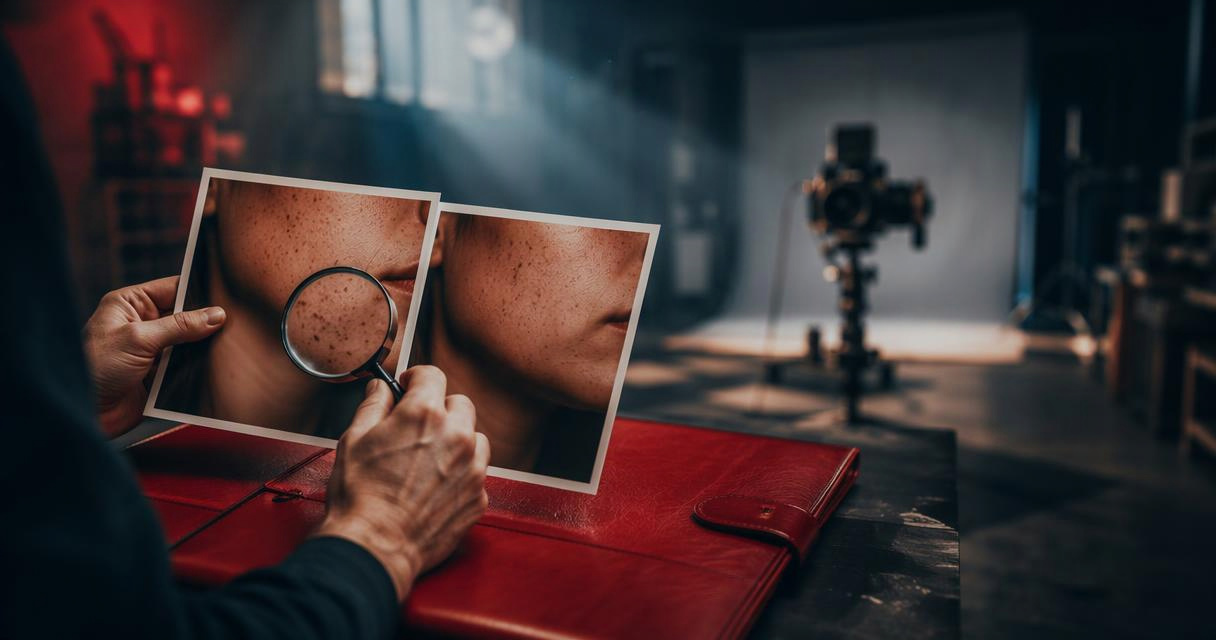
Your freckles are part of your likeness, not a filter setting. Choosing the best AI portrait generators for preserving freckles means putting that likeness at the center of the brief. For personal images spanning dating profiles, lifestyle portraits, and polished online photos, HotphotoAI is a relevant starting point. I'd make faithful skin detail a selection requirement alongside lighting, outfits, and backgrounds.
Freckle preservation: Keeping the recognizable placement, clustering, and appearance of freckles from a reference photograph in the generated portrait.
Table of Contents
What counts as genuine freckle preservation?
Genuine freckle preservation means an AI portrait retains recognizable freckle patterns from the reference, rather than merely producing freckled skin. Compare clusters, gaps, and distinctive marks across the nose and cheeks. Exact pixel matching isn't the goal when lighting or pose changes; recognizable continuity is the useful standard.
Separate identity detail from decorative texture
A convincing portrait and a faithful portrait aren't necessarily the same thing. An image can contain beautifully rendered freckles that belong to nobody in particular. That's decoration, not preservation.
I'd inspect a few recognizable clusters rather than count every spot. A small group beneath one eye or a clear gap on one cheek makes a better checkpoint than overall freckle density.
Three outcomes to distinguish
These categories separate likeness preservation from changes that only look plausible.
| Outcome | What you see | What it means |
|---|---|---|
| Preserved | Recognizable clusters remain in corresponding areas | Useful continuity with the reference |
| Invented | New clusters replace the original arrangement | Freckled appearance, changed identity detail |
| Erased | Visible reference freckles disappear | Skin detail hasn't been retained |
A freckled face isn't automatically your freckled face. Judge the pattern, not the aesthetic.
Which portrait generators belong on your shortlist?
A useful shortlist starts with personal-photo tools and includes alternative generation or editing workflows, but the supplied research doesn't establish a tested freckle-preservation winner. I'd compare candidates using the same source images and portrait brief. The table below is a testing shortlist, not a performance ranking.
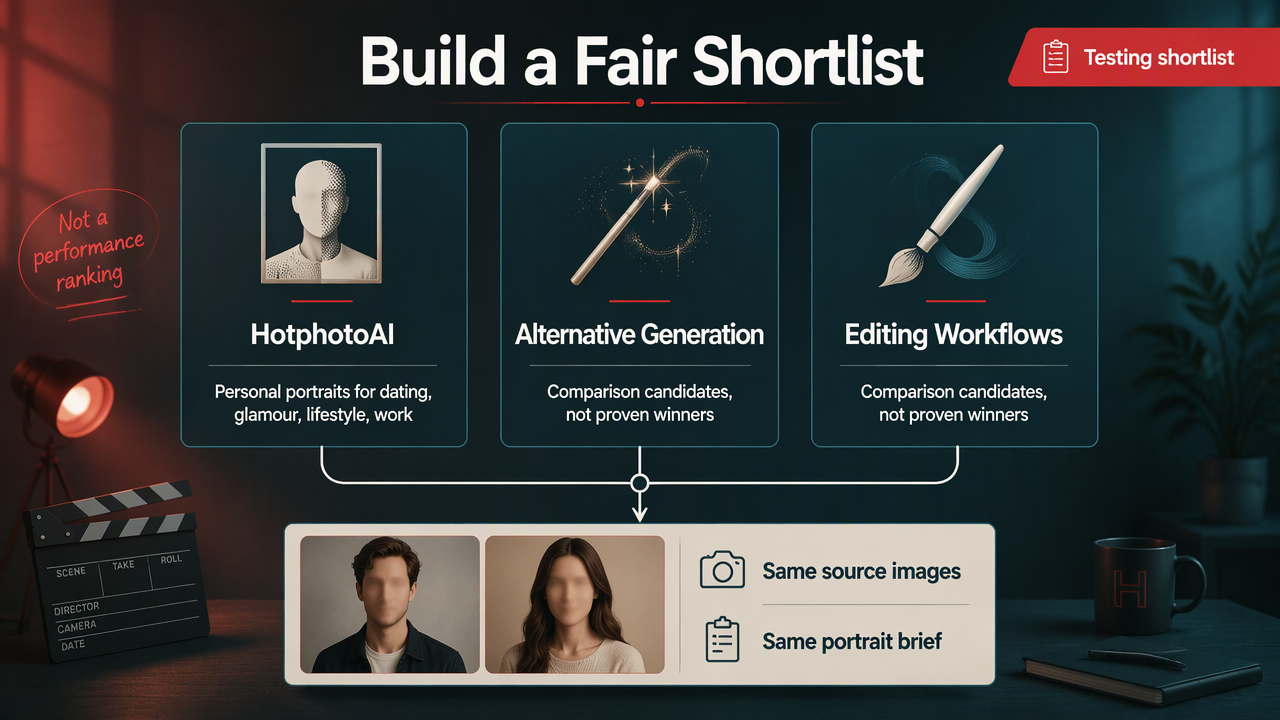
Candidate tools and the questions worth testing
HotphotoAI belongs first for its personal-portrait focus, which aligns with readers seeking dating, glamour, lifestyle, or professional images. The other candidates offer comparison points; their inclusion doesn't establish that they preserve freckles.
| Candidate | Proposed role in your comparison | Evidence needed before choosing |
|---|---|---|
| HotphotoAI | Personal-photo styling aligned with your intended profile | Matching clusters across your selected outputs |
| ChatGPT image generation | A conversational portrait brief to evaluate | Reference-to-output likeness checks |
| Midjourney | A stylized portrait candidate to evaluate | Continuity of distinctive skin details |
| Adobe Photoshop | An editing-based comparison candidate | Whether your chosen workflow retains original facial detail |
No controlled results for these tools were supplied. Before testing, check current reference-image options, pricing, privacy terms, and permitted uses directly with each provider.
Who should pick which: I'd start with a personal-photo platform when the goal is a ready-to-use profile portrait. For a creative character image, prioritize style. When identity fidelity matters most, favor whichever tested workflow changes the original face least, regardless of brand.
How HotphotoAI handles this
The useful role for a personal-portrait platform is to combine your desired presentation with an explicit likeness brief. Start by describing the intended image: a relaxed dating portrait, a polished professional photo, or a glamour image with natural skin texture.
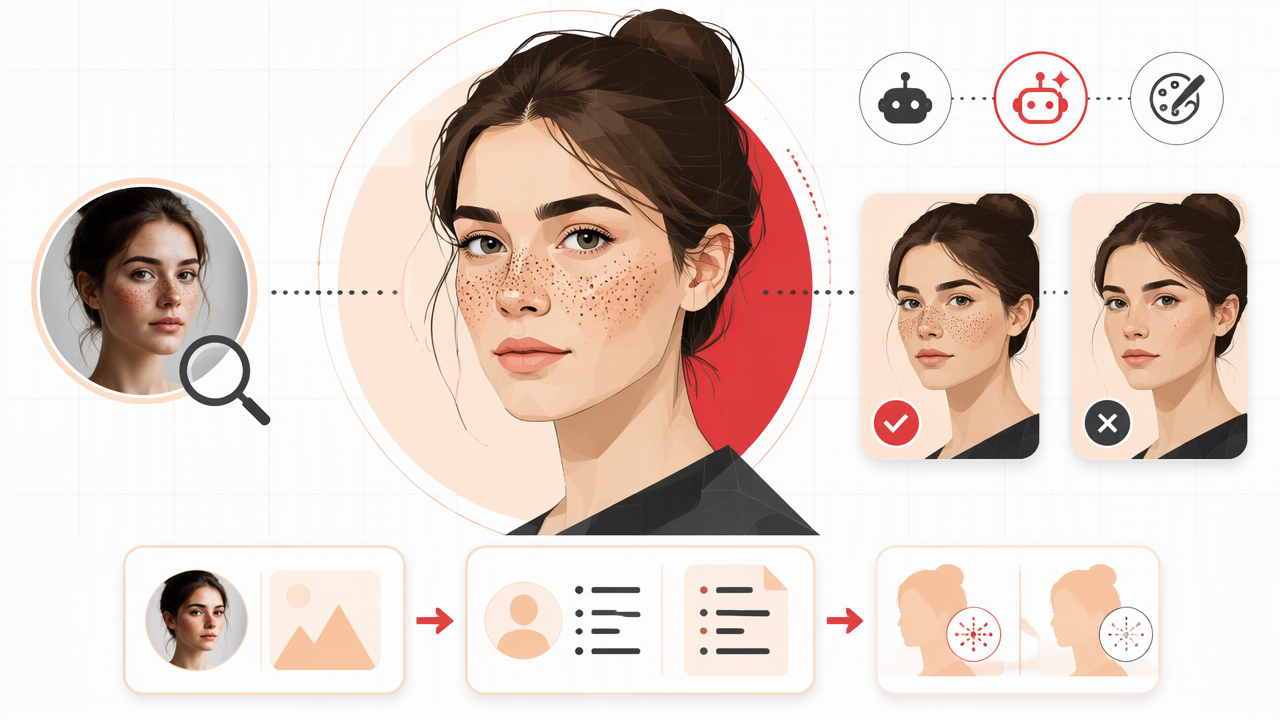
Build the brief around recognizable skin
For HotphotoAI, I'd make recognizable freckles part of the creative brief wherever the current workflow allows instructions or reference selection. Its personal-image focus makes that request relevant to the task, rather than an afterthought.
- Choose references where your freckles are easy to see.
- Specify the desired outfit, background, and lighting separately.
- Ask for natural skin texture and the reference freckle pattern.
- Select the output that best matches both your face and your intended use.
A suggested instruction is: Keep the reference person's recognizable freckle clusters and natural skin texture. Use soft daylight and a relaxed portrait composition.
This is a proposed brief, not a documented product guarantee. Check the available controls before planning your session. Keeping the styling request specific gives you a clear target for evaluating the finished portrait.
How do you compare freckle retention fairly?
- Test AI portrait freckle retention using photographs of consenting adults.
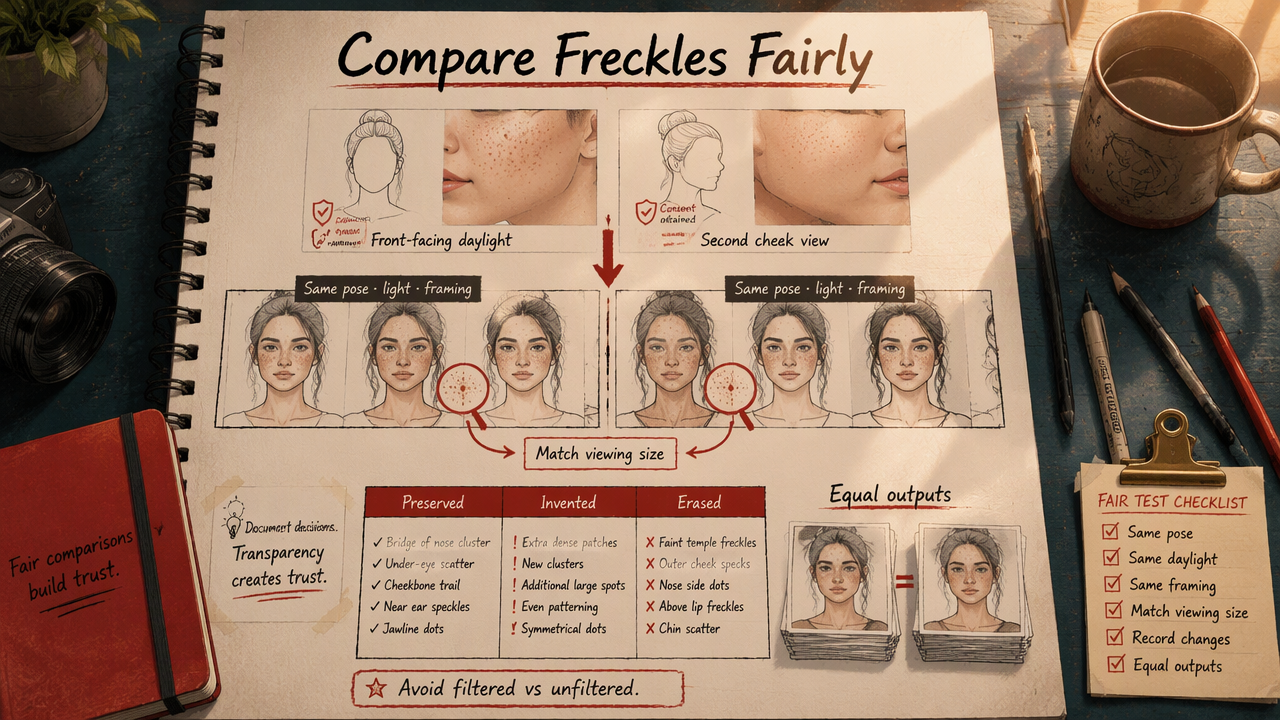
- Give each candidate the same references and portrait brief.
- Keep the requested pose, lighting, and framing consistent.
- Compare distinctive clusters at matching viewing sizes.
- Record preserved, invented, and erased details separately before selecting an image.
Run a small, repeatable comparison
I'd start with a front-facing daylight photo and a second view showing the cheek patterns. Avoid comparing a heavily filtered reference with an unfiltered one. Keep the number of outputs equal across tools so one candidate doesn't win simply because it received more attempts.
Record your observations in plain language: nose cluster retained, left-cheek gap retained, or right-cheek pattern changed. These are proposed evaluation labels, not findings from a completed test.
For dating profiles, compare the selected portrait with a recent ordinary photo. Your match should recognize you, not request a character reboot.
Understand what the available research supports
The supplied scholarly sources provide context, not tool rankings. A 2021 Nature Machine Intelligence paper on AI-generated characters concerns personalized learning and well-being. A 2022 deepfake survey concerns malicious synthetic media. Neither supplied record establishes freckle-retention scores.
Publish a result as tested only when you can show the references, outputs, settings, and evaluation method.
FAQ: Choosing a freckle-faithful portrait
The right choice depends on your intended use and the likeness you can verify.
Can a prompt guarantee that my freckles stay unchanged?
A prompt alone isn't evidence that your freckles stayed unchanged. It describes the result you want; the output still needs checking. Compare distinctive clusters and gaps with your reference, especially when the requested lighting or pose differs. I'd treat natural-looking freckles as a starting point, not proof of preservation.
Should I choose the most realistic-looking result?
Choose the most faithful result when the portrait represents you on a dating or professional profile. Realistic texture can coexist with altered facial details. For fantasy portraits, you may reasonably prioritize creative style, but label the image appropriately where its context could otherwise suggest an ordinary photograph.
What should I check before uploading reference photos?
Check the provider's current privacy policy, retention terms, deletion options, and rules about uploaded faces. Use your own images or obtain permission from the adult pictured. If the portrait includes another person, crop them out unless their participation is necessary and they have agreed to the intended use.
Conclusion
Choose your target style and gather two clear reference photos before starting. For a personal-portrait session with HotphotoAI, visit hotphotoai.com and check the current options. Then run one consistent brief and compare recognizable freckle clusters before publishing. A polished portrait should still feel unmistakably like you.