Photo Shoppe vs AI Portrait Studio: Which Is Better for Polished Personal Photos?
TL;DR
AI portrait studios are usually faster and more flexible for dating photos, social content, fantasy portraits, and polished profile images. A local photo shop or photographer still wins when you need true realism, hands-on direction, group shots, or guaranteed authenticity.
A great profile photo can do more work than a bio, which is slightly unfair to everyone who owns a thesaurus. The photo shoppe vs AI portrait studio decision now matters because personal images are no longer just headshots; they are dating assets, creator thumbnails, LinkedIn signals, and sometimes tiny acts of reinvention. A traditional photographic studio, according to the standard definition, is a business where photographers create and sell photographs, often with assistants, equipment, and sets. AI portrait studio: a software-based tool that generates or transforms personal portraits from uploaded images, prompts, styles, and model training. For users who want model-style, lifestyle, or glamour images without booking a shoot, HotphotoAI fits the modern side of that choice.
Table of Contents
What is the real difference between a photo shoppe and an AI portrait studio?
A photo shoppe captures you in a physical session, while an AI portrait studio creates styled portraits from digital inputs. The practical difference is not "real versus fake"; it is camera-first production versus software-first image generation.
Traditional studios give you a person, a camera, lighting, a room, and a scheduled appointment. You get direction, live feedback, and a result tied to how you looked in that moment. That matters when trust is part of the photo's job.
AI portrait studios give you speed, variations, and creative range. Instead of one outfit and one backdrop, you can test a dozen looks: rooftop casual, editorial black-and-white, soft studio lighting, fantasy armor, or clean professional portraits.
Key insight: Choose a studio when the session itself improves the result; choose AI when variation and speed are the main goal.
Core terms for quick comparison
- Photo shoppe: a local or studio-based photography service for posed, edited, or printed images.
- AI portrait studio: a digital portrait generator that creates stylized personal images from uploads and prompts.
- Retouching: editing skin, lighting, background, color, or composition after capture.
- Creative control: how much you can change style, setting, mood, outfit, and final look.
Photo shoppe vs AI portrait studio: which gives better results?
The better result depends on whether you value authenticity, direction, and physical realism or variety, styling freedom, and fast iteration. In my view, the smartest users do not treat these as enemies; they treat them as two different machines for two different jobs.
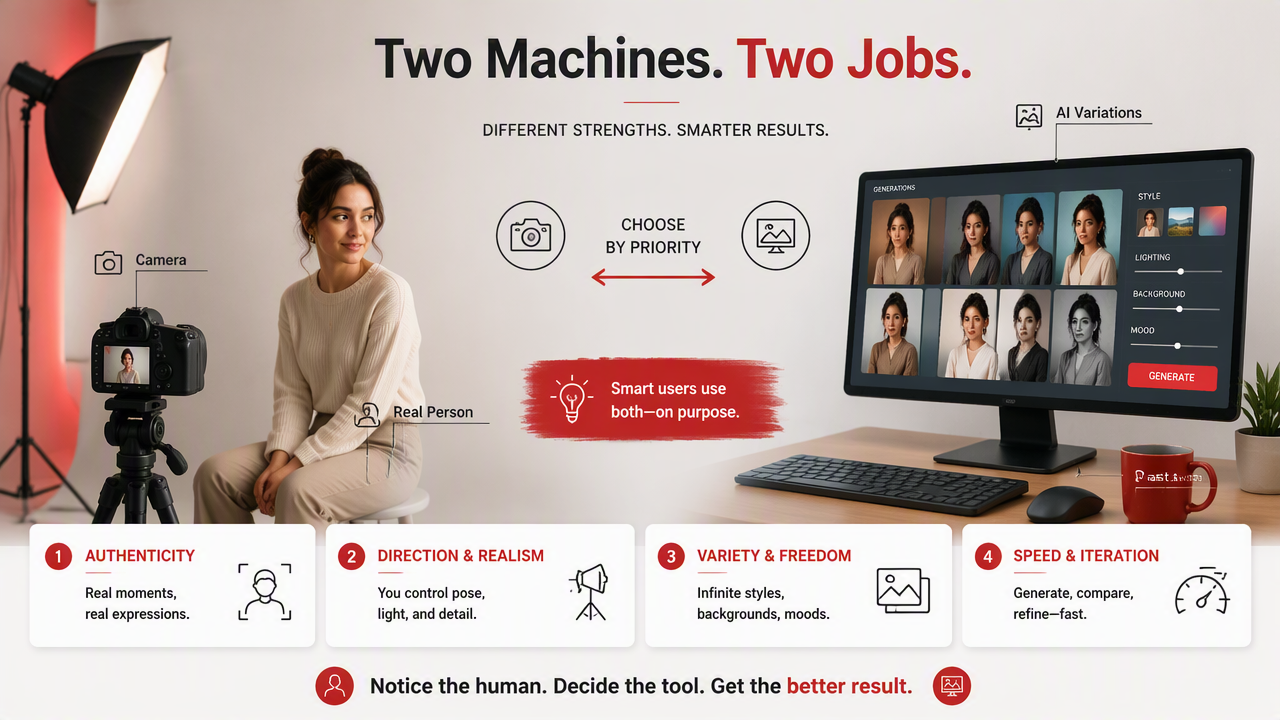
A photographer can notice posture, nervous smiles, glasses glare, jaw angle, and awkward hand placement. AI can create scenes that would be expensive or impractical in a local shop, especially if you want several visual identities for Tinder, Instagram, X, LinkedIn, or creator branding.
The 2026 SERP is crowded, with research showing 938,000,000 results around this comparison space and competitor pages averaging 2,153 words. That noise explains why a clean decision table beats a sermon with lighting equipment in it.
Decision table for personal portraits
| Need | Photo shoppe | AI portrait studio | Better pick |
|---|---|---|---|
| Dating app variety | Limited by session time | Many outfits, moods, and scenes | AI portrait studio |
| Corporate realism | Strong, especially with a pro | Good if inputs are strong | Photo shoppe |
| Glamour or fantasy looks | Possible, but costly | Built for style experiments | AI portrait studio |
| Live posing help | Excellent | Not available in the same way | Photo shoppe |
| Fast content refresh | Slower booking cycle | Quick new sets | AI portrait studio |
| Family or group portraits | Natural and reliable | Harder to keep everyone consistent | Photo shoppe |
How do convenience, control, privacy, and cost compare?
AI portrait studios usually win on convenience and creative control, while local studios often win on human guidance and verifiable capture. The tradeoff is simple: less travel and more options on one side, more physical certainty on the other.
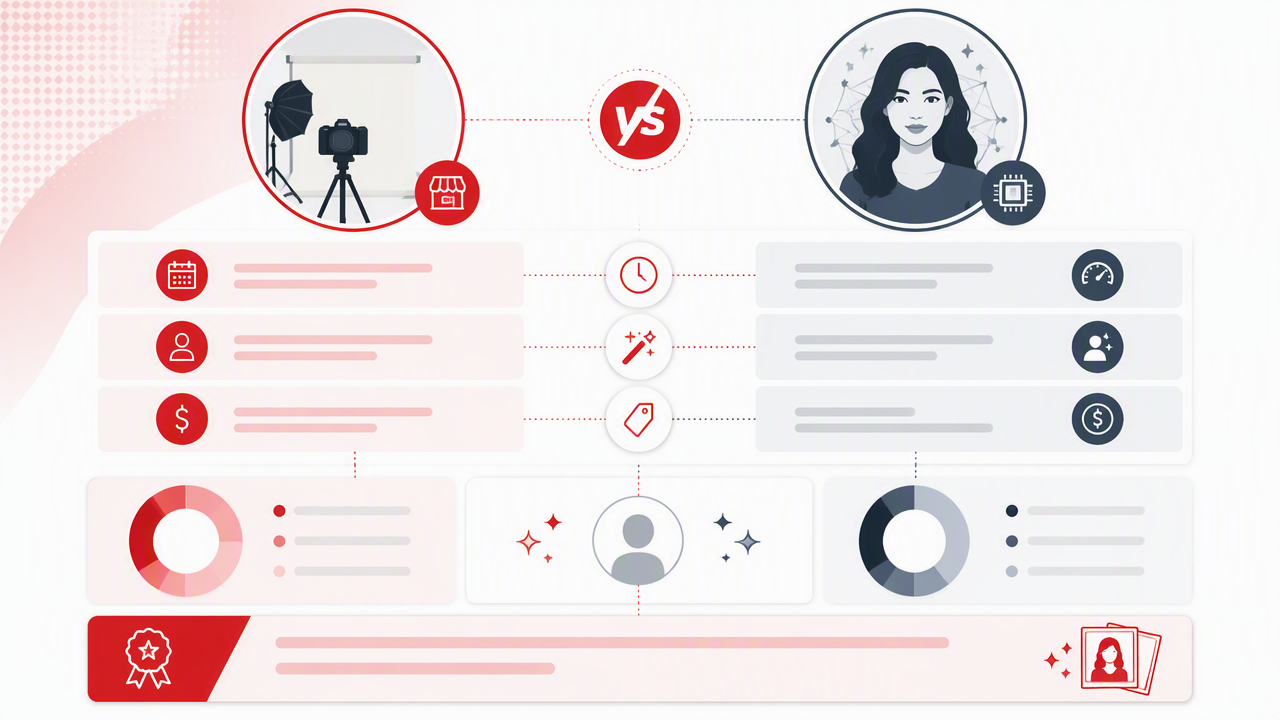
A local studio asks you to schedule, travel, choose clothes, pose, review proofs, and wait. That can be worth it if you freeze in front of cameras or need a photographer to coach you. The camera does not lie, but it does occasionally make people look like they just heard a tax audit joke.
AI tools shift the work to selection. You choose source photos, styles, prompts, and outputs. With HotphotoAI, for example, the main benefit is generating polished personal portraits across looks that would normally require wardrobe changes, lighting changes, and location changes.
Privacy deserves a grown-up answer. Any route involving personal images requires trust: a studio stores files, and an AI service processes uploads. Read policies, avoid uploading images you would not want processed, and choose services that clearly explain how images are handled.
Fast checklist before choosing
- Decide the photo's job: dating, social, creator, professional, or fantasy.
- Pick the realism level you need: documentary, polished, stylized, or imaginative.
- Check how soon you need the images.
- Consider whether you need posing help.
- Review privacy terms before uploading or booking.
- Compare the total effort, not just the listed price.
When should you still choose a real photographer?
You should choose a real photographer when trust, physical accuracy, live direction, or shared experience matters more than volume. AI has range, but a skilled photographer still catches human details software can miss.
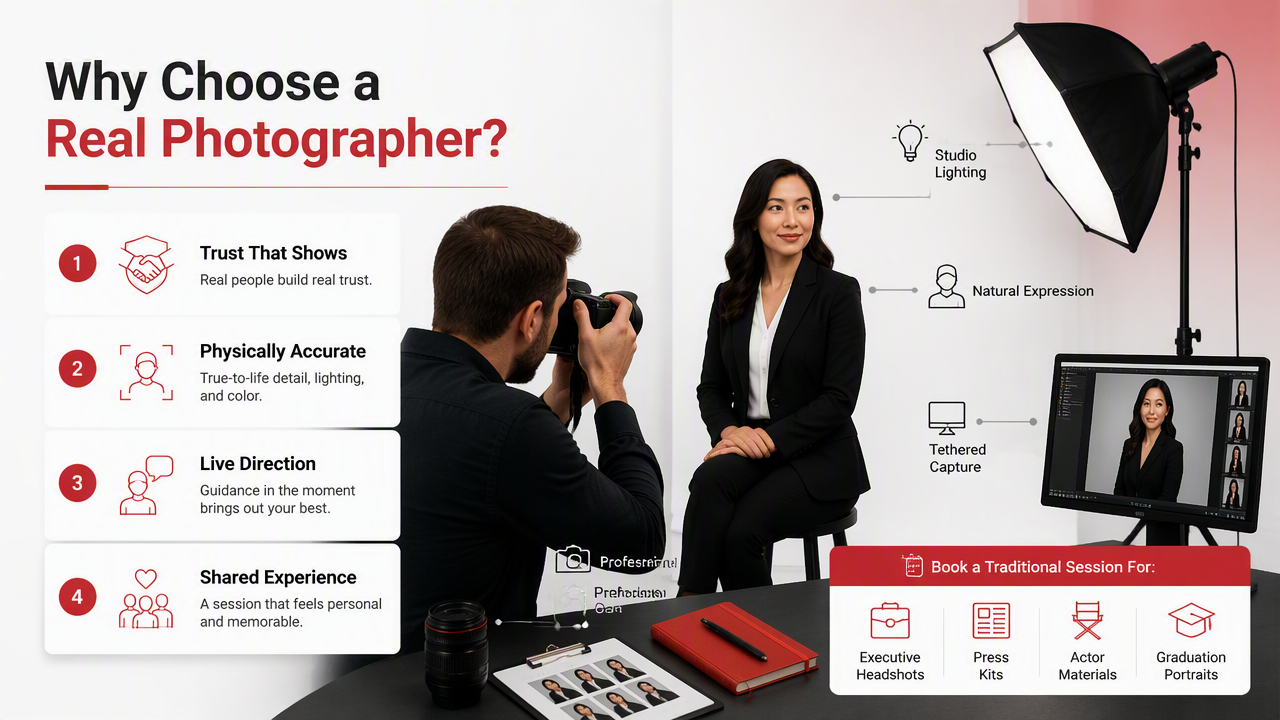
Book a traditional session for executive headshots, press kits, actor materials, graduation portraits, couples photos, family images, and anything where another person needs to believe the image documents a real day. A photographer also helps if you dislike being photographed, since live coaching can fix posture and expression faster than endless regeneration.
Use AI when the photo's purpose is personal branding, styling exploration, creative self-presentation, or testing what looks good before a real shoot. Many people can use AI portraits as a mood board, then bring the best styles to a photographer later.
Best hybrid move: Use AI to discover your strongest outfits, angles, colors, and backgrounds, then book a photographer for the final "yes, I was really there" version.
Situations where the human session is worth it
- You need images for identity-sensitive or official use.
- You want natural interaction with another person in the frame.
- You need precise lighting for print, press, or portfolio work.
- You want a photographer's taste, not only tool output.
- You care about documenting a real event, not creating a styled possibility.
FAQ: choosing between local studios and AI portraits
Smart buyers should match the image method to the image's purpose, not to hype. Below are the questions I would ask before spending money or uploading a single selfie.
Are AI portraits good enough for dating apps?
AI portraits can be strong for dating apps when they still look like you and avoid over-styled fantasy. Use them for variety, better lighting, and lifestyle scenes, but keep at least one natural, recent photo in the mix. If every image looks like a perfume ad, people may assume the profile is trying too hard.
Is a photo shoppe better for LinkedIn photos?
A photo shoppe or professional photographer is often better for conservative LinkedIn use because the result feels more verifiable and grounded. An AI portrait can work for polished personal branding if it preserves your real features, uses a believable background, and avoids fashion-magazine intensity. For senior roles, I would stay closer to reality.
Can AI replace a glamour photoshoot?
AI can replace some glamour shoots when the goal is experimentation, stylized portraits, or fantasy concepts. It is especially useful for trying outfits, lighting moods, and dramatic backgrounds. It does not fully replace the confidence boost, body posing, and collaborative direction of a great in-person session.
What should I try first if I am unsure?
Start with AI if you want to test looks quickly and cheaply before committing to a full shoot. Save your favorite outputs as a style reference. Then, if you need real-world authenticity or a premium final image, bring those references to a photographer. That order reduces guesswork and wardrobe panic.
Conclusion
The photo shoppe vs AI portrait studio choice is really a question of purpose. Pick a local photographer for verified realism, live coaching, and meaningful occasions. Pick AI for fast variety, stylized portraits, dating-photo experiments, and creative self-presentation. If you want to start with polished digital options, try the HotphotoAI platform and compare several looks before booking anything. For the next step, head to hotphotoai.com, choose the image goal first, then build the portraits around that goal.