Photobooth Photo Booth vs AI Photo Booth: Which Makes Better Photos in 2026?
TL;DR
Choose a physical photo booth for live events, instant prints, and group fun. Choose an AI photo booth or portrait generator when you need polished dating, social, model-style, or professional images with more control over outfits, lighting, and backgrounds.
The photobooth photo booth vs AI photo booth choice is no longer just "prints or pixels." In 2026, it's a decision about where the image is made, how much control you want, and whether the goal is party entertainment or a profile photo that makes your ex quietly regret their life choices. For personal portraits, HotphotoAI fits the AI side well because it creates stylized personal images without booking a studio, renting lighting, or pretending a crowded event corner is your best angle.
Table of Contents
What is an AI photo booth?
An AI photo booth is a digital image experience that uses artificial intelligence to transform an uploaded or captured photo into a stylized portrait, avatar, themed scene, or branded event image. A traditional photo booth, by contrast, is a kiosk or vending-machine-style setup with an automated camera and, historically, a film processor, though most booths today are digital.
Photo booth: A physical kiosk or event setup that captures photos on-site and often prints or shares them instantly.
AI photo booth: A software-led experience that applies AI generation, face-aware editing, background changes, outfit styling, or artistic effects to create new-looking images from input photos.
The real split is output. A classic booth records the moment. An AI booth reimagines it. One says, "Here is what happened." The other says, "Here is you as a luxury campaign, sci-fi pilot, dating profile upgrade, or suspiciously well-lit founder headshot."
Key insight: Pick a traditional booth for shared memories; pick AI when the final image matters more than the moment of capture.
Photobooth photo booth vs AI photo booth: quick comparison
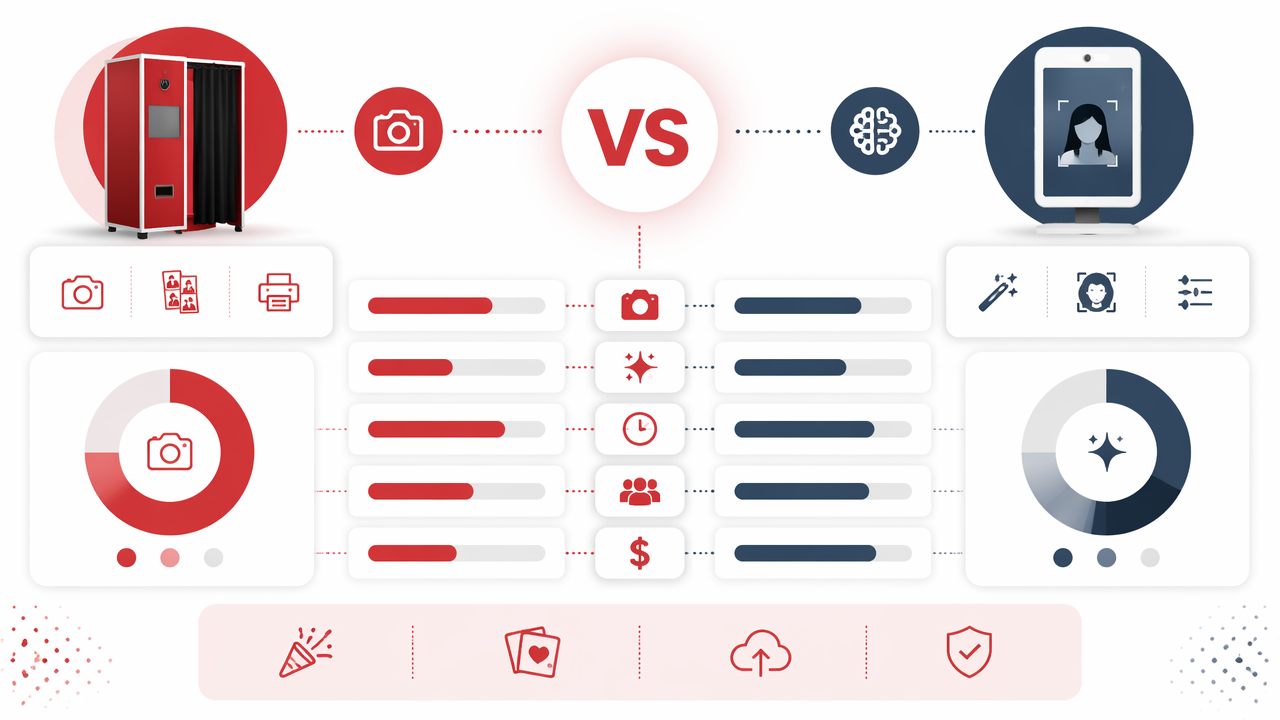
A traditional booth wins on live entertainment, while an AI booth wins on personalization, reuse, and controlled portrait outcomes.
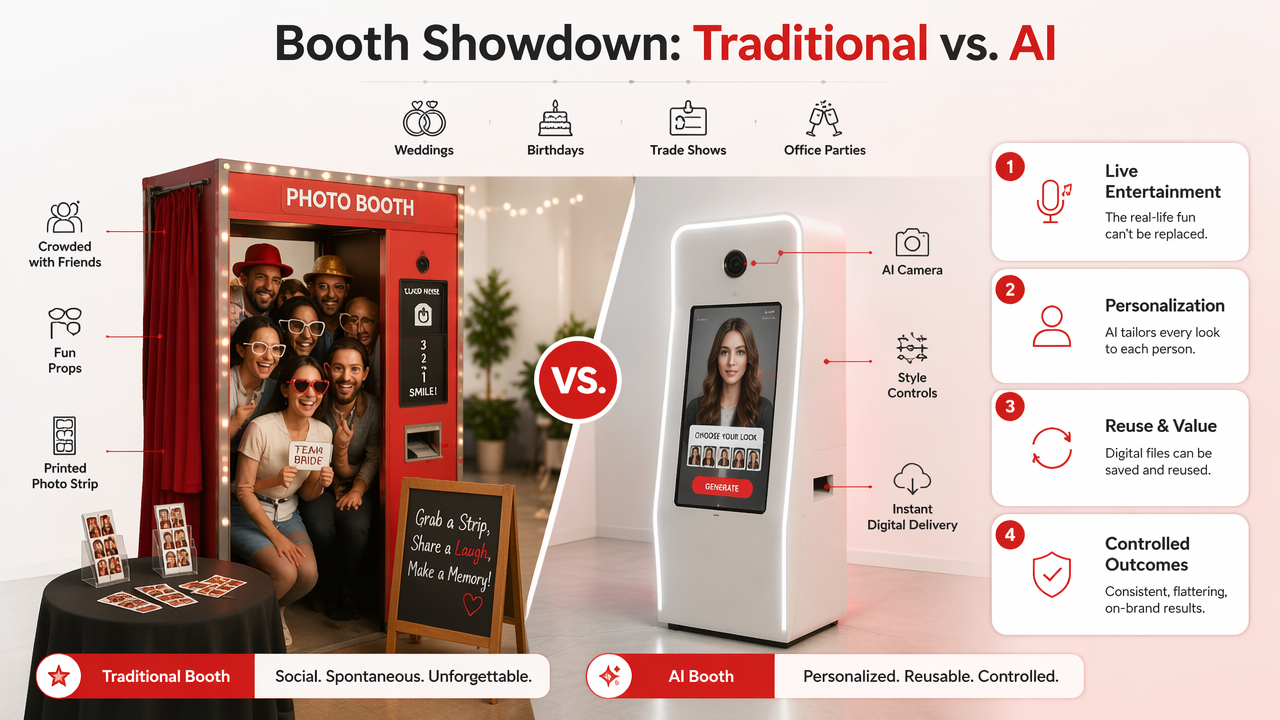
For weddings, birthdays, trade shows, and office parties, the physical booth still has charm. People squeeze in, grab props, laugh at the countdown, and walk away with a strip. That social friction is the feature, not the bug.
For dating apps, creator content, fantasy portraits, and professional profiles, AI has the practical edge. You can test looks, scenes, and moods without waiting for an event or hoping the booth lighting forgives you.
Comparison table for real-world decisions
| Factor | Traditional photo booth | AI photo booth or portrait tool | Best pick |
|---|---|---|---|
| Main purpose | Captures live moments | Creates styled image variations | Depends on goal |
| Convenience | Requires a booth, venue, or rental | Works from uploaded photos | AI |
| Pose control | Limited by space and timer | More flexible through prompts and references | AI |
| Realism | Strong for candid event photos | Varies by tool and input quality | Tie |
| Prints | Often built in | Usually digital first | Traditional booth |
| Dating profile use | Fun, but often cramped or prop-heavy | Strong for flattering lifestyle shots | AI |
| Social media content | Good for event posts | Better for themed, polished visuals | AI |
| Professional profiles | Usually too casual | Better for clean, polished portraits | AI |
| Group fun | Excellent | Less social unless event-based | Traditional booth |
| Privacy focus | Depends on vendor and event setup | Depends on platform policies and uploads | Read terms |
I'd use a booth when the room matters: weddings, reunions, launches, parties. I'd use AI when the image has a job to do: get matches, build a creator look, refresh LinkedIn, or test a visual identity before paying a photographer.
Which option is better for dating, social, and professional profiles?
AI photo tools are usually better for dating, social media, and professional profiles because they offer more control over style, background, lighting, and image variety.
Dating and profile photos are not souvenirs. They are tiny billboards for your face, taste, lifestyle, and confidence. That's why a random event booth shot can be funny but rarely becomes the lead image on Tinder, Hinge, Instagram, or LinkedIn.
The best choice depends on the job your photo needs to do.
Best scenarios by image goal
- Dating apps: Use AI portraits for natural-looking lifestyle shots, better lighting, outfit variety, and cleaner backgrounds. Keep at least one real candid photo so your profile doesn't look like a perfume ad with trust issues.
- Instagram or creator content: Use AI when you want fantasy, glam, fashion, seasonal, cinematic, or themed visuals at scale.
- LinkedIn and resumes: Use AI for polished headshots if the result still looks like you on a Monday morning, not you after being acquired by a luxury watch brand.
- Events and parties: Use a traditional booth when people want keepsakes, group shots, instant prints, and a shared activity.
- Brand activations: Use AI event booths when the goal is branded, shareable content, avatars, or custom scenes.
A 2025 study in npj Science of Food by Suzannah Gerber, Hyeryeon Bae, and Isabella Ramirez examined how perceived value, politics, and identity are socially constructed in public tasting experiences, not photo booths specifically. Still, it points to a useful principle for images: people read identity cues quickly, and visual framing changes perceived value (Nature).
How HotphotoAI handles personal image goals
The HotphotoAI platform is best framed as a personal portrait option, not an event rental. It helps users create attractive, stylized images for dating profiles, social posts, glamour looks, lifestyle scenes, and professional online presence.
That matters because most people don't need a booth in their living room. They need 10 to 30 usable images that make them look confident, current, and visually consistent. AI makes that practical without a makeup chair, rented backdrop, or friend saying "one more" for 45 minutes.
What should you check before choosing either booth type?
Choose based on output rights, privacy, realism, delivery speed, and whether you need an experience or finished portraits.
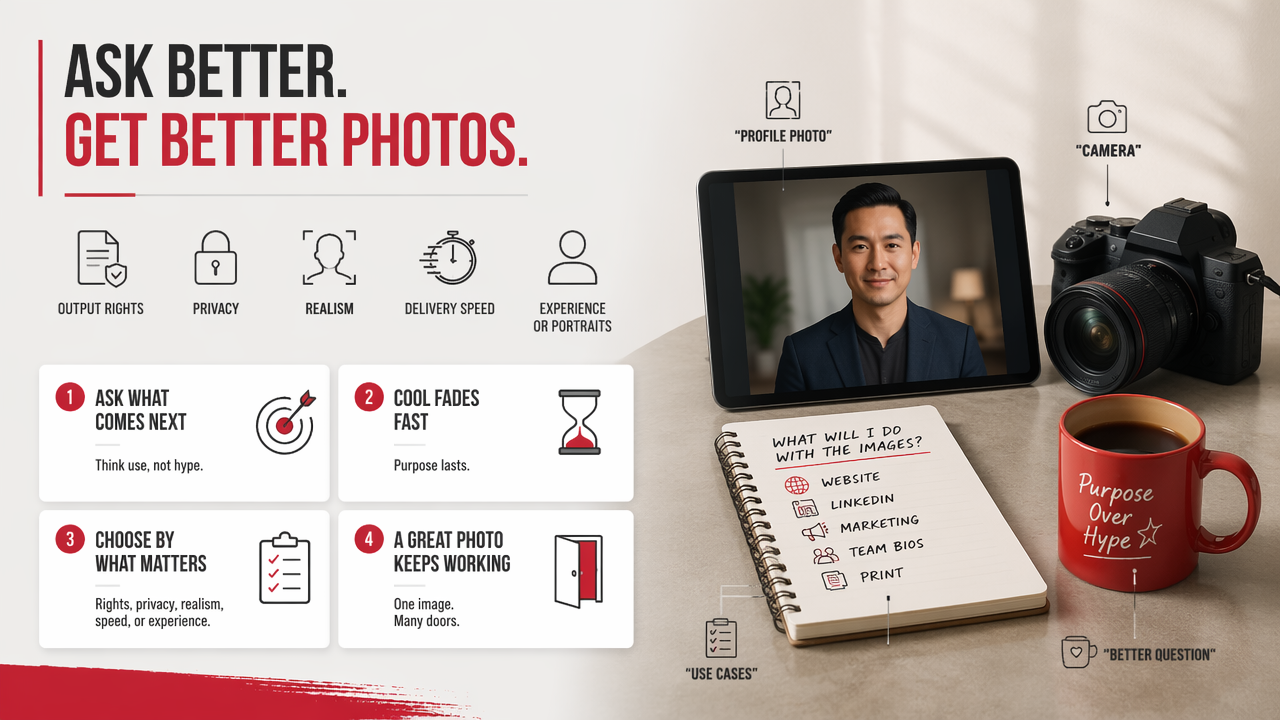
A lot of bad photo decisions start with the wrong question. "Which is cooler?" is less useful than "What will I do with the images after I get them?" Cool fades quickly. A great profile photo keeps working while you sleep, which is honestly rude but helpful.
Decision checklist before you pay
- Define the goal: Event entertainment, keepsake prints, dating photos, professional headshots, or branded content.
- Check image rights: Confirm whether you can use the outputs commercially, socially, or only personally.
- Review privacy terms: Look for how uploads, guest data, and generated images are stored or deleted.
- Test realism: Avoid outputs where hands, teeth, eyes, or face shape look off.
- Match the format: Prints need a booth; profile variety usually needs AI.
- Plan delivery: Events need instant sharing; personal portraits can allow a short generation window.
Rule of thumb: If the experience is the product, rent a booth. If the final photo is the product, use AI.
Common mistakes that make results worse
- Using booth photos as primary dating images when they are dark, crowded, or full of props.
- Choosing AI styles that change your face too much.
- Ignoring platform fit, since LinkedIn, Tinder, Instagram, and a speaker bio need different levels of polish.
- Forgetting consent when uploading group images.
- Picking novelty over believability.
The safest path is variety. Use one polished image, one natural candid, one social proof shot, and one context photo that shows taste or lifestyle. A profile with only perfect AI images can feel oddly sterile, like a hotel lobby learned to flirt.
What will photo booths look like in 2027?
By 2027, photo booths will likely split into two clearer categories: live event systems for shared experiences and AI portrait systems for personalized digital identity.
Event vendors are already positioning AI booths around custom scenes, branded activations, instant sharing, and avatar-style outputs. Traditional options like glam booths, pro booths, and 360 booths will still matter because parties need movement, laughter, and physical presence.
Personal users, though, will keep moving toward AI portrait packs. The reason is simple: people update online profiles more often than they attend formal photoshoots. If you need new looks for dating, creator content, or a professional refresh, head to hotphotoai.com and compare what AI can produce from the photos you already have.
Top AI booth features to expect next
- Better face consistency across multiple outfits and backgrounds.
- More realistic lighting control for studio, outdoor, nightlife, and editorial looks.
- Brand-safe event templates for sponsors, conferences, and product launches.
- Faster mobile delivery through QR codes, galleries, and direct downloads.
- Stronger consent controls for guest images and uploaded references.
- More profile-specific presets for dating apps, creator bios, speaker pages, and business profiles.
The winners won't be the tools with the wildest effects. They'll be the ones that make people look like themselves on an unusually good day.
Frequently asked questions
Photo booth choices usually come down to occasion, control, and trust, not just image style.
Is an AI photo booth the same as an AI headshot generator?
Not exactly. An AI photo booth often refers to an event or interactive experience that transforms photos on the spot. An AI headshot or portrait generator is usually personal and upload-based. The overlap is growing, but the use case differs: event engagement versus controlled profile-ready images.
Are traditional photo booths still worth it in 2026?
Yes, traditional booths are still worth it for weddings, parties, reunions, and corporate events because they create a shared activity and instant keepsakes. They are less ideal when you need polished dating, creator, or professional profile photos, since lighting, posing, and background control are limited.
Can AI photo booth images look realistic?
AI images can look realistic when the input photos are clear and the tool preserves face shape, skin texture, and natural lighting. Results look weaker when styles are overdone or the system changes key features. For profile use, realism should beat fantasy unless the goal is clearly creative.
Which is better for Tinder photos?
AI portraits are usually better for Tinder if they look natural, varied, and believable. Use them to improve lighting, outfits, and settings, but mix in real candid photos too. A profile should feel attractive and trustworthy, not like a casting sheet for someone you might never meet.
Conclusion
The photobooth photo booth vs AI photo booth decision is really about purpose. Choose the physical booth when you want live fun, prints, and group memories. Choose AI when you want controlled, polished images for dating, social media, glamour portraits, or professional profiles. My practical next step: list where you'll use the photos, pick three styles you need, then create a small test set before replacing every profile image. For personal portrait experiments, try HotphotoAI or visit hotphotoai.com and build a set that fits your actual online goals.