Picture Booth Photos From Selfies: How to Get the Booth Look Without the Booth
TL;DR
Photo booth style works because it gives selfies structure: even lighting, tight crops, simple backgrounds, and playful expression. To recreate it, start with clear selfies, choose a consistent visual style, and use AI tools to produce polished profile, dating app, creator, or party images without renting a booth.
Picture booth photos from selfies are popular because they make casual images feel intentional, like someone brought a tiny red carpet and sensible lighting to your camera roll. A traditional photo booth, according to Wikipedia's definition, is an automated kiosk with a camera and film processor, though most booths are now digital. In 2026, the same visual language can be recreated from uploaded selfies using AI portrait tools, including HotphotoAI, so the booth look is no longer trapped inside malls, weddings, and suspiciously sticky party props.
Table of Contents
What makes picture booth photos from selfies appealing?
Picture booth photos from selfies work because they combine flattering consistency with human spontaneity: soft lighting, simple crops, repeated framing, expressive poses, and a background that does not fight for attention. The result feels more polished than a regular selfie but less stiff than a studio portrait.
Picture booth photo: a portrait styled to look like it came from a digital photo booth, usually with close framing, clean lighting, a plain or themed backdrop, and a sequence-friendly pose.
The appeal is partly social. Research on visual media by Richard Rogers in Big Data & Society examines how Instagram and other platforms can be studied through images, not just captions or hashtags, which matches how people now judge profile presence visually first: Visual media analysis for Instagram and other online platforms.
Key insight: the booth effect is not magic. It is repeatable visual discipline wearing a party hat.
The four visual ingredients that create the booth effect
| Ingredient | What it does | Selfie version |
|---|---|---|
| Even lighting | Smooths shadows and keeps the face readable | Face a window or use soft front light |
| Tight crop | Makes the image feel intimate and intentional | Crop from chest or shoulders up |
| Simple background | Keeps attention on expression | Use a wall, curtain, car interior, or AI backdrop |
| Expressive pose | Adds personality and movement | Try smirk, laugh, side glance, or over-the-shoulder |
Real booths also add consistency. Every frame has the same distance, lighting, and perspective, which makes even silly expressions look coordinated. That is why a strip of imperfect booth shots often feels more charming than one over-edited selfie.
How do you turn selfies into booth-style portraits?
To turn selfies into booth-style portraits, choose clear source photos, keep the face visible, remove visual clutter, pick one booth mood, generate several variations, and save only images that still look like you. AI can improve lighting, backgrounds, styling, and composition while preserving the casual booth feeling.
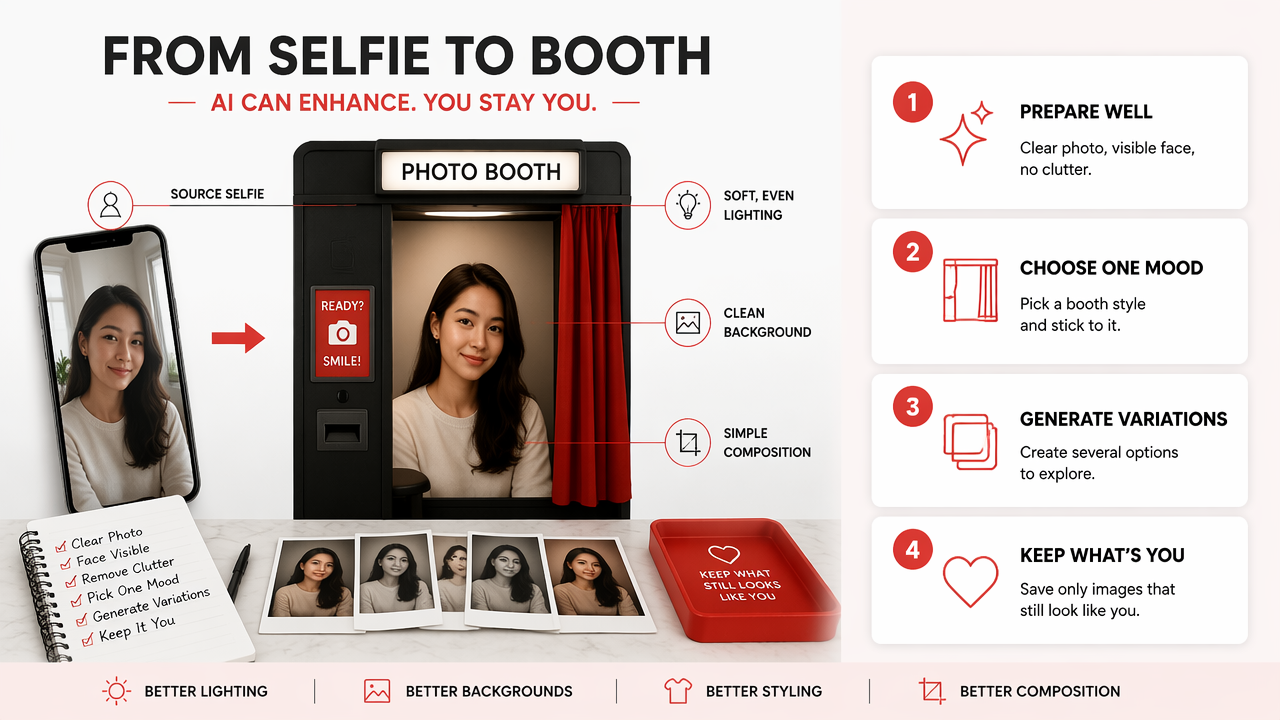
A practical selfie-to-booth workflow
- Start with 6 to 12 usable selfies. Pick images where your face is sharp, not hidden by sunglasses, heavy filters, or extreme angles.
- Choose one mood. Examples include glossy party booth, black-and-white strip, retro arcade, luxury event, office headshot booth, or cinematic date-night portrait.
- Keep the crop close. Booth photos rarely show the whole body. Shoulders, face, and hands usually do the heavy lifting.
- Ask for consistent lighting. Soft frontal light beats dramatic side shadows if you want the classic booth charm.
- Generate a batch, then edit down. The best result is usually not the first image. It is the one where your expression, face shape, and styling all agree.
- Use the image where it fits. A playful booth shot can work on Instagram, while a cleaner version is better for LinkedIn or a dating profile.
I like using the HotphotoAI platform for this kind of task because the goal is not just to beautify a selfie. The useful trick is turning ordinary inputs into a specific scene, outfit, lighting setup, or profile-ready style. If you want to test that workflow, head to hotphotoai.com with a few clear photos and one visual direction in mind.
Selfie inputs that give AI the best chance
- Use different expressions, not twelve copies of the same bathroom mirror face.
- Include natural light photos when possible.
- Avoid heavy beauty filters in the source images.
- Mix straight-on and slight-angle shots.
- Keep hair, glasses, facial hair, and features visible.
The boring rule is also the most useful one: better inputs create better outputs. AI can invent a velvet curtain, a flash-lit party wall, or a magazine-style crop, but it should not have to guess what your face looks like.
Where should you use AI photo booth images?
AI photo booth images are most useful where you need variety, personality, and polish without booking a photographer: dating apps, social profiles, creator posts, party visuals, personal branding, and themed portraits. The format works best when the image matches the platform's social expectation.
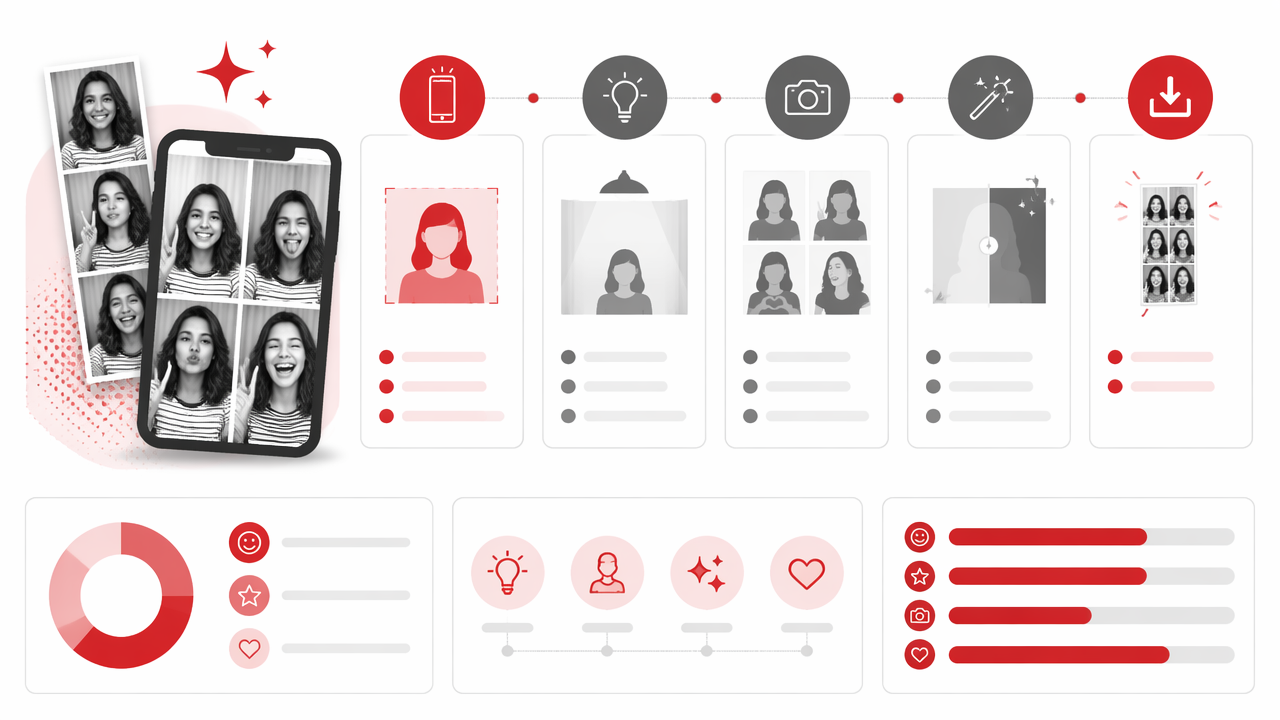
Best use cases by platform and goal
| Use case | Best booth style | Why it works |
|---|---|---|
| Tinder or Hinge | Bright lifestyle booth, candid smile, clean outfit | Adds variety beyond car selfies and group crops |
| Retro strip, flash party booth, stylized backdrop | Feels post-worthy without looking corporate | |
| TikTok creator profile | Bold color, expressive face, recognizable styling | Reads quickly in small profile circles |
| LinkedIn or portfolio | Minimal booth crop, neutral background, polished lighting | Looks professional but not lifeless |
| Event invite or recap | Themed party booth, props, matching color palette | Creates a shared visual identity |
| Fantasy or glamour portraits | Model-style lighting, wardrobe changes, cinematic set | Gives a photoshoot feel without the photoshoot calendar drama |
Dating profiles benefit most from range. One polished portrait can help, but five identical glamour shots can feel suspicious. Mix one booth-inspired close-up with lifestyle, full-body, and social-context images.
Why creators and brands care about image consistency
AI image analysis research by Richard Rutter, Stuart J. Barnes, and Stuart Roper studied influencer imagery, product placement, and engagement relationships: Social media influencers, product placement and network engagement. The practical lesson for creators is simple: visuals carry signals before anyone reads the caption.
A booth-inspired set gives creators a repeatable format. You can change outfits, expressions, and backgrounds while keeping the same framing. That makes a feed look planned, but not laminated.
What should you avoid when recreating the booth look?
The biggest mistakes are over-smoothing the face, using too many props, choosing busy backgrounds, forcing unrealistic lighting, and posting images that no longer resemble you. A good booth-style image should feel upgraded, not like your selfie joined witness protection.
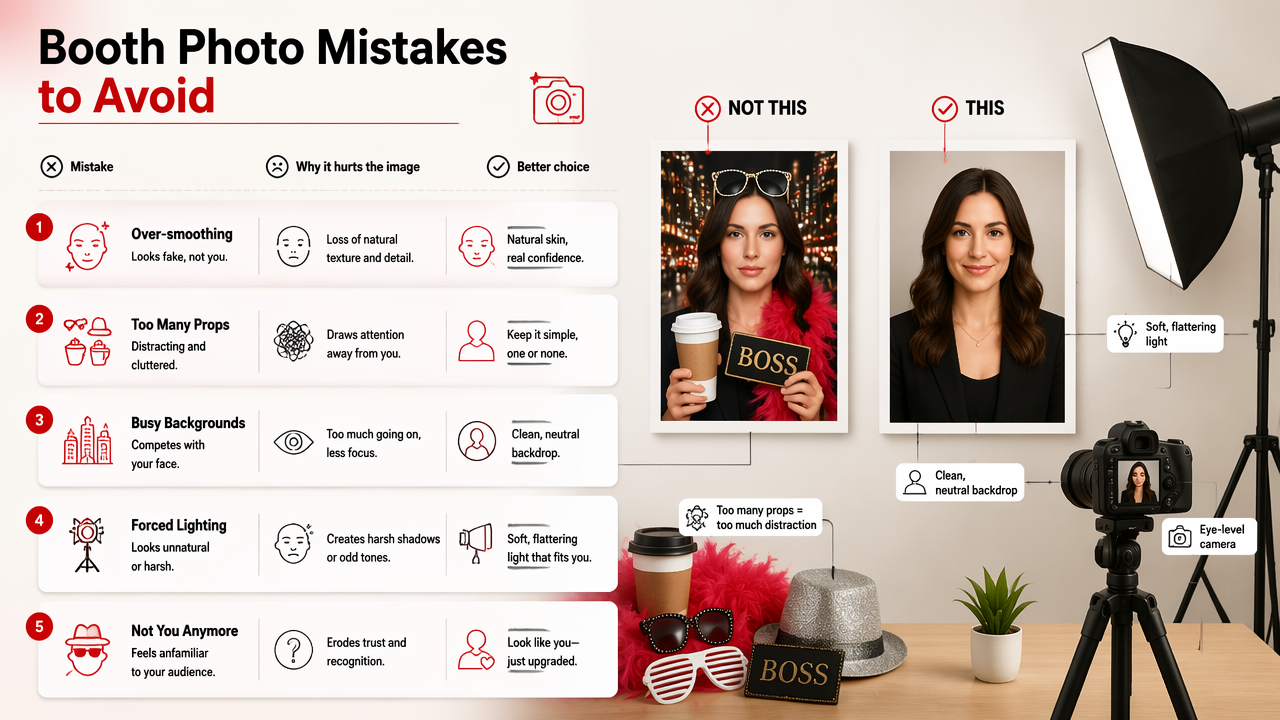
Common mistakes and better fixes
| Mistake | Why it hurts the image | Better choice |
|---|---|---|
| Plastic skin | Makes the portrait look artificial | Keep natural texture and light retouching |
| Too many props | Pulls attention from your face | Use one visual idea at a time |
| Overly complex backdrop | Fights the booth aesthetic | Pick curtains, color walls, or simple patterns |
| Mismatched identity | Breaks trust on dating or work profiles | Keep facial features recognizable |
| Same expression in every image | Makes a set feel robotic | Mix smile, laugh, neutral, and playful looks |
Authenticity matters more for dating and professional use than for fantasy portraits. A dragon-castle glamour image can be wonderfully dramatic, but it should not be the only photo on a dating profile unless your date is also bringing a dragon.
A 2022 paper by Mega Febriani Sya, Novi Anoegrajekti, and Ratna Dewanti explored the educational value of popular fantasy material in learning design: Exploring the Educational Value of Indo-Harry Potter. For portraits, the related point is that themed imagery can communicate identity and taste quickly, but it still needs context.
FAQ: quick answers about selfie-based booth photos
Selfie-based booth photos sit between casual selfies and studio portraits, so the best results come from clear source images, restrained styling, and a platform-specific goal. Use them as part of a broader image mix, not as a total replacement for every real-life photo.
Can AI really make selfies look like photo booth pictures?
Yes, AI can recreate the booth look by adjusting lighting, crop, background, pose styling, and overall mood. The result depends heavily on the quality of the uploaded selfies. Clear, varied images usually produce more believable booth-style portraits than blurry, filtered, or heavily angled photos.
How many selfies should I upload for better results?
A practical starting point is several clear selfies with different expressions and angles. Use straight-on photos, slight side angles, natural smiles, and neutral expressions. The goal is to give the AI enough facial information to create variety without drifting away from your real appearance.
Are booth-style AI photos good for dating apps?
They can be strong dating app photos when used in moderation. A booth-style portrait can show confidence, style, and personality, but it should sit beside more natural images. I would avoid using only AI-styled photos, because matches usually want visual variety and real-world cues.
What styles work best for professional profiles?
For professional profiles, choose clean lighting, a simple background, natural grooming, and a close crop. Avoid loud props, fantasy styling, and heavy retouching. A polished booth-style headshot can work well when it looks approachable and current rather than staged or overly glossy.
Conclusion
Picture booth photos from selfies work because they borrow the best parts of the booth experience: flattering light, tight framing, simple scenes, and expressive little moments. Start with clear selfies, pick one style, generate variations, and keep only the images that still look like you on a very good day.
For a polished set, try one dating-app version, one creator-style image, one professional crop, and one playful party look. With HotphotoAI, you can experiment with outfits, lighting, and backgrounds without renting a booth or pretending a ring light is a social life. Visit hotphotoai.com when you are ready to turn your camera roll into something profile-worthy.